
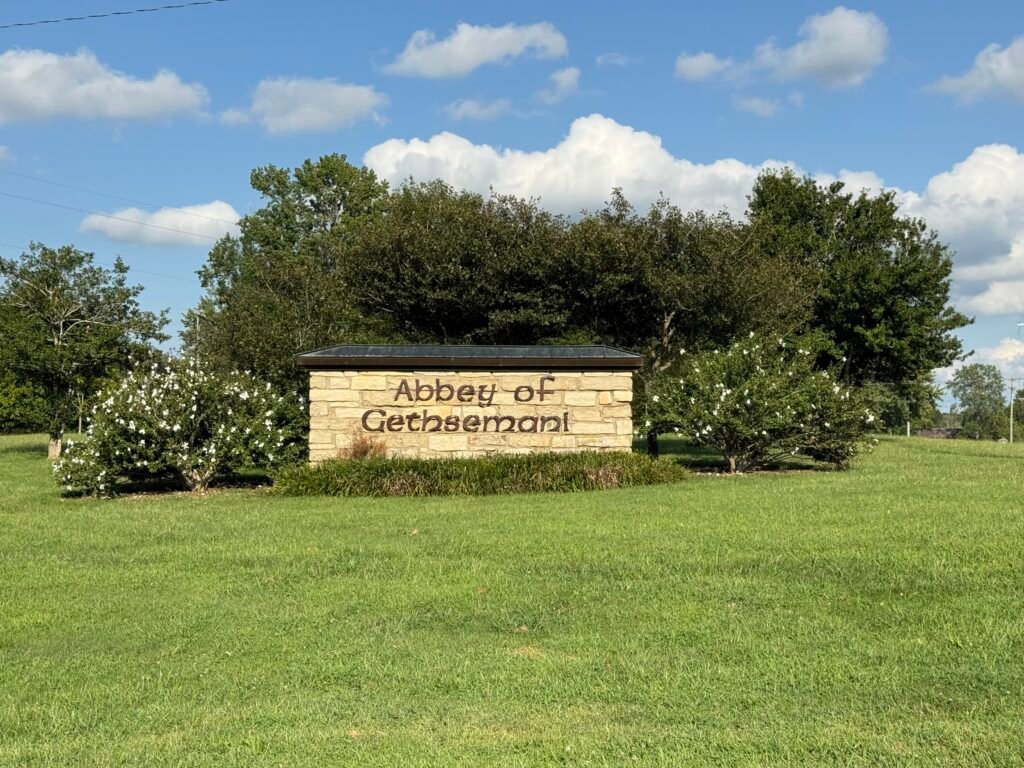
(Click any image to enlarge)
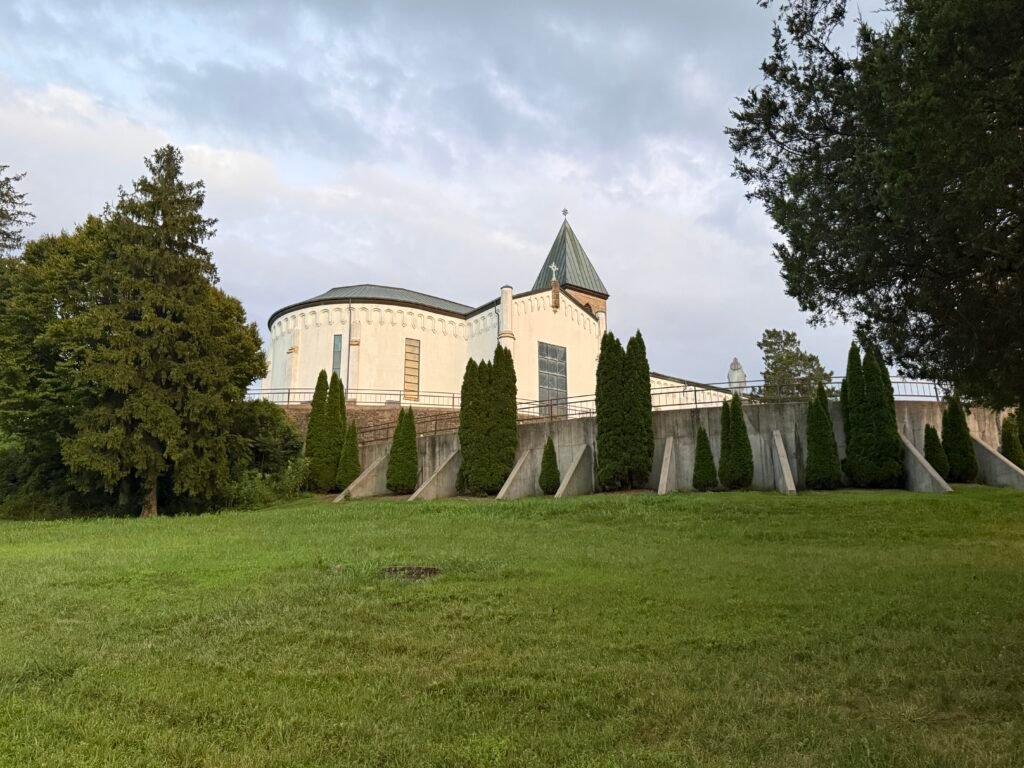
Deep in the rolling knobs and pastures of central Kentucky, there’s an unassuming property along a two-lane road you could drive past without a second thought. A stone sign. A historical marker. A drive climbing gently away from the highway toward a collection of buildings that are, for a place with this much history, surprisingly plain.
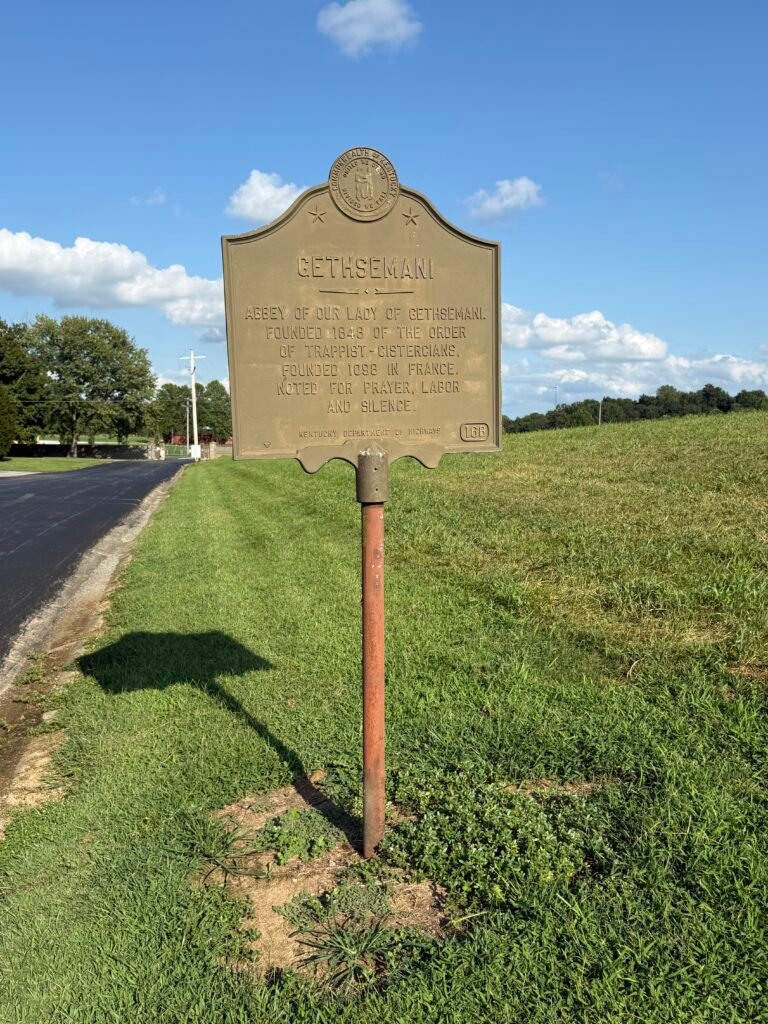
This is the Abbey of Gethsemani.
Founded in 1848 by monks from the Abbey of Melleray in France, it is the oldest continuously operating Trappist monastery in the United States—Trappist being the popular name for the Order of Cistercians of the Strict Observance, monks descended from the older Cistercian reform of Benedictine monasticism. Its full name, the Abbey of Our Lady of Gethsemani, carries two layers worth knowing. “Our Lady” is Mary, to whom Cistercian houses are traditionally dedicated. “Gethsemani” is the garden where Jesus withdrew with his disciples the night before the Crucifixion—a place of watching, withdrawal, and prayer. For a monastery built around exactly that rhythm, the name isn’t incidental. It’s the whole plan, stated up front.
Today the community numbers around forty. For more than 175 years they’ve divided their days among prayer, work, reading, and silence—a life chosen deliberately, not fallen into. It’s a vocation built on the conviction that withdrawal from the world, sustained and structured, is itself a form of devotion rather than an escape from one. Nobody stumbles into this life by accident; every man in that cemetery chose the life, and most of them chose it for decades.
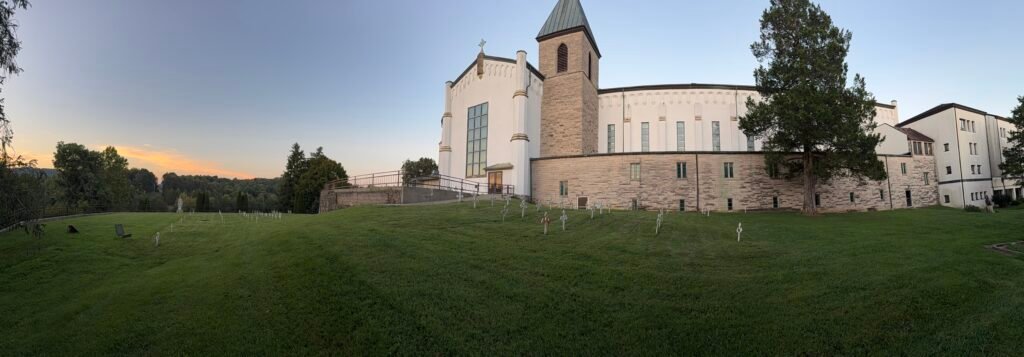
And several times a week, they let the rest of us in.
Not entirely. This is a working monastery, not a religious-themed hotel. Fences, signs, and enclosure walls mark territory reserved for the monastic community, and guests are expected to respect them without exception. But Gethsemani has taken in retreatants since its founding, following the old Benedictine instruction that a guest is to be received as Christ himself. Today that means silent, unstructured retreats open to men and women of any faith—or none.
I came for several days in August with no particular program in mind.
Turns out that’s exactly how you’re supposed to do it.
Seven Times a Day
Stay at Gethsemani and you learn fast that the day doesn’t belong to you.
It belongs to the bells.
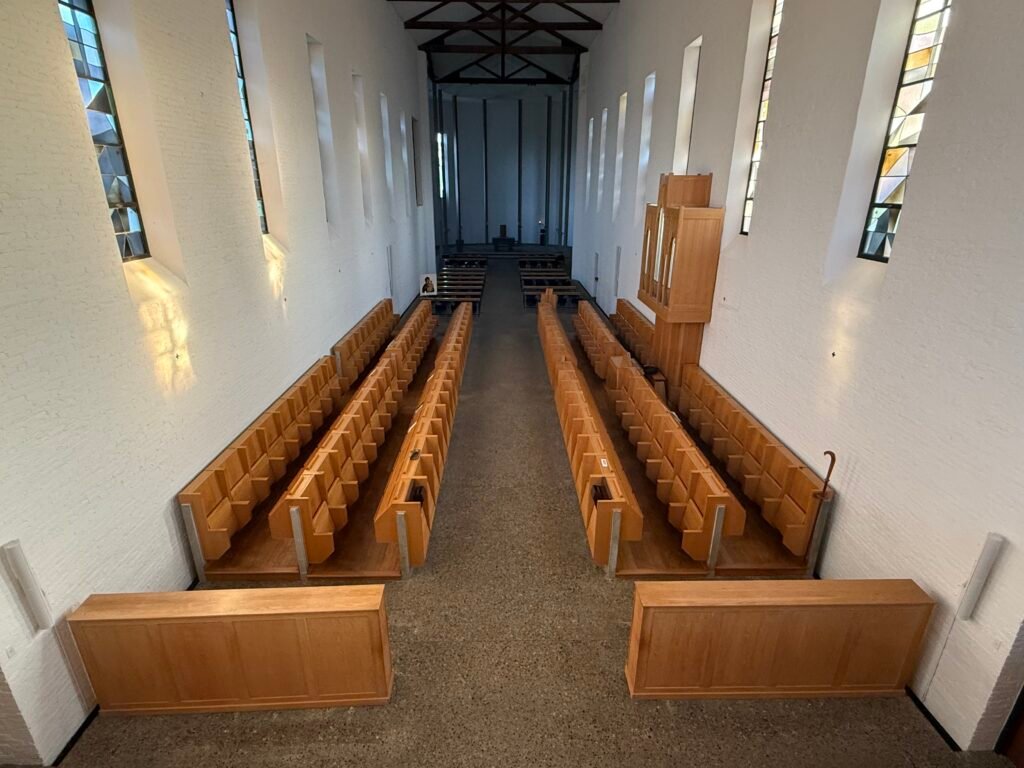
The full schedule, posted just inside the entrance, runs: Vigils at 3:15 a.m., Lauds at 5:45 (6:45 on Sundays and solemnities), Terce at 7:30, Sext at 12:15, None at 2:15, Vespers at 5:30, Compline at 7:30. Weekdays, Lauds is followed immediately by Mass. Sundays rearrange the order somewhat, but the shape holds: seven interruptions scattered through the day, eight if you count Mass separately.
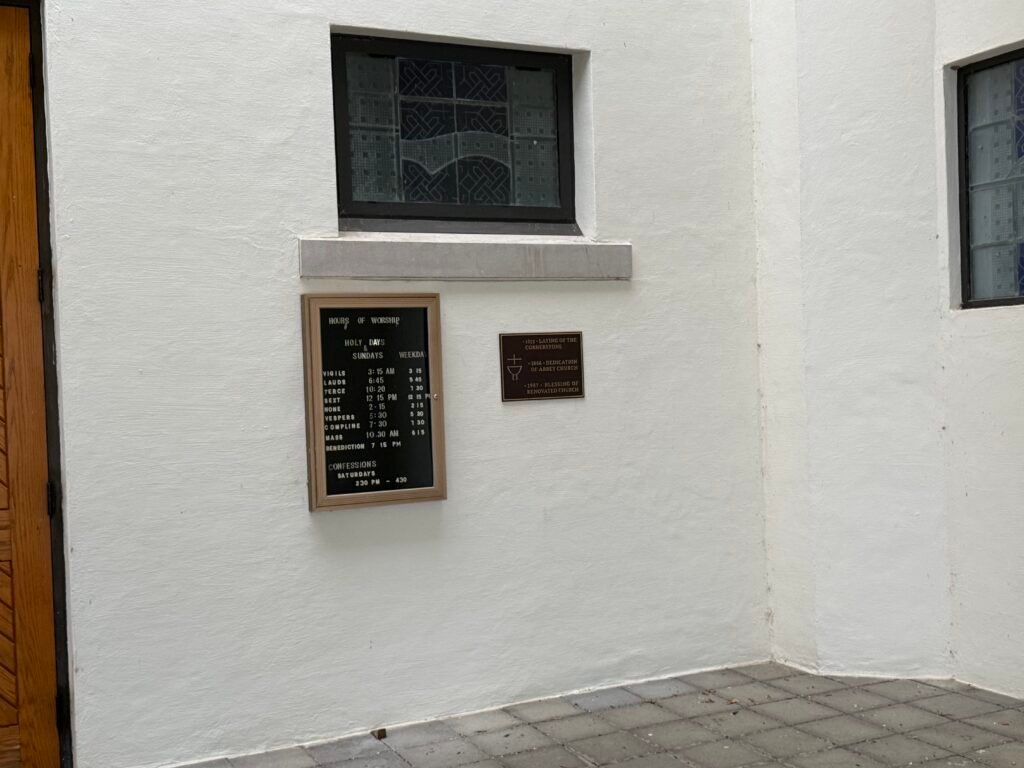
I made it through the full cycle exactly once, on my third day. Every office, the Sunday Mass, 3:15 in the morning to Compline that night. It nearly wrecked me. I’d tried to be in bed by 10 the night before and still needed a two-hour nap after Terce just to keep functioning. Lauds plus a full Mass, back to back, runs long in a way you don’t appreciate until you’re sitting through it on no sleep. This is not a schedule for the faint of heart, and nobody at the Abbey pretends otherwise.
The names sound exotic for about a day. Then they just become the shape of time. Vigils arrives in full darkness, the longest and starkest of the offices—psalms and long readings, watching while the rest of the world sleeps. Lauds turns toward the beginning of the day. Terce, Sext, and None interrupt the working hours like a hand on the shoulder. Vespers gathers the day back in. Compline closes it.
Then silence, until Vigils again.
The monks work and read and practice lectio divina between the offices—slow, prayerful reading meant to be sat with rather than mined for information. Then a bell rings, and whatever they were doing simply stops.
There’s something useful in that, if your ordinary life mostly consists of deciding what deserves your attention next. Here, your thoughts don’t decide what happens next.
The bell does.
There’s no real sense of the clock at Gethsemani—not because time doesn’t matter, but because you stop tracking it yourself. At 6:55 each morning I learned to listen for a single bell. Five minutes later, breakfast. No notification, no calendar alert, no vibration against the wrist.
Bong. Breakfast.
Civilization may have overcomplicated this.
Not Quiet, But Peaceful
Gethsemani describes its retreats as silent, unstructured, undirected. Silent deserves a footnote.
The place isn’t actually quiet. Cicadas spend August running what sounds like a competitive chainsaw convention. A dove coos somewhere; a crow announces itself and moves on. Squirrels and chipmunks chatter through the branches and underbrush. Somewhere in that underbrush something makes a low, insistent chuck-chuck that I never did identify—if I didn’t know better, I’d have sworn it was a monkey, though Kentucky, as far as I’m aware, has none. A toad sat motionless in the clover by the trail. A tiny five-lined skink evaded my camera for two full days before finally holding still long enough on a stone wall. One evening a small feather drifted down and landed on my knee while I read; I never saw where it came from.
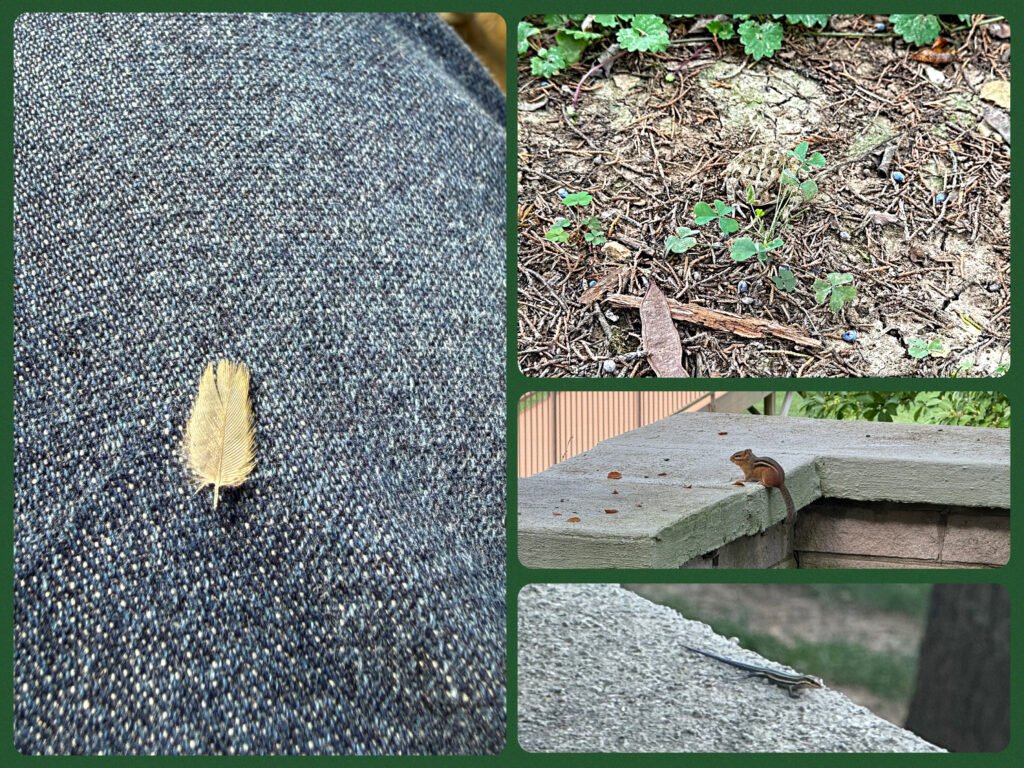
None of that is silence, strictly speaking. But the place feels quiet. Peaceful might be the better word.
Most areas used by retreatants are designated for silence, and while there are spaces where conversation is permitted, nobody polices it with a ruler. They don’t need to. Within a surprisingly short time, you stop wanting to make much noise yourself.
That changes things. Ordinary life is full of conversational filler—words spoken because someone else is in the room, silence filled because silence feels awkward, a phone reached for because three unoccupied minutes apparently require remediation. At Gethsemani, nobody cares if you sit under a tree for forty-five minutes doing nothing at all.
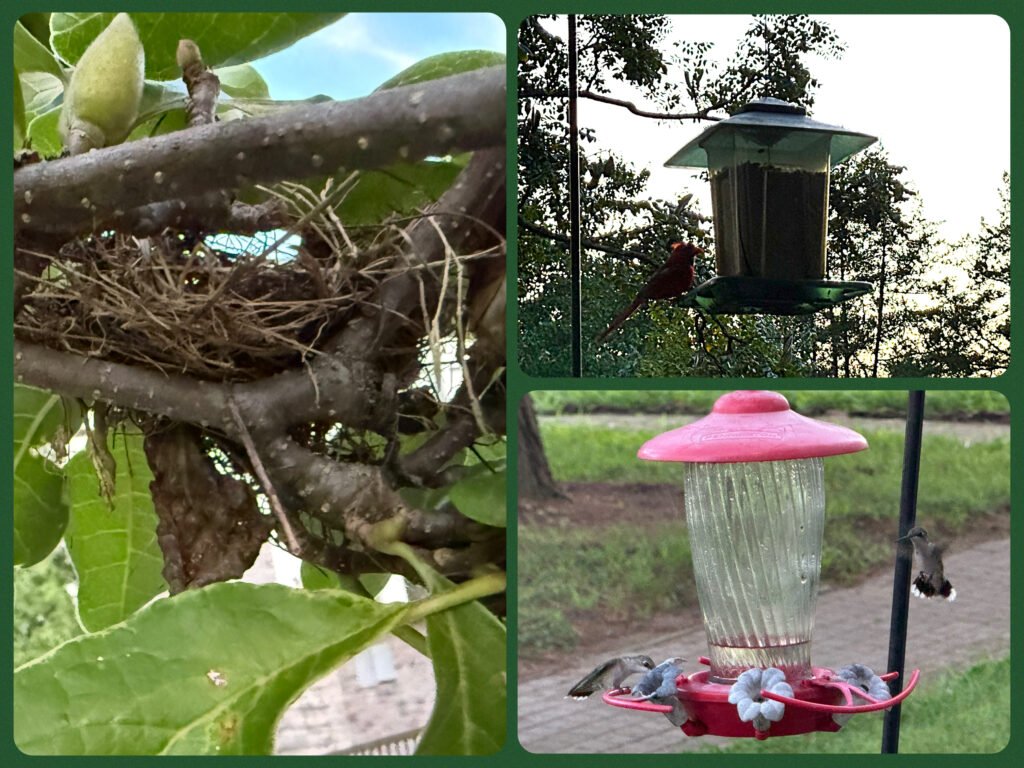
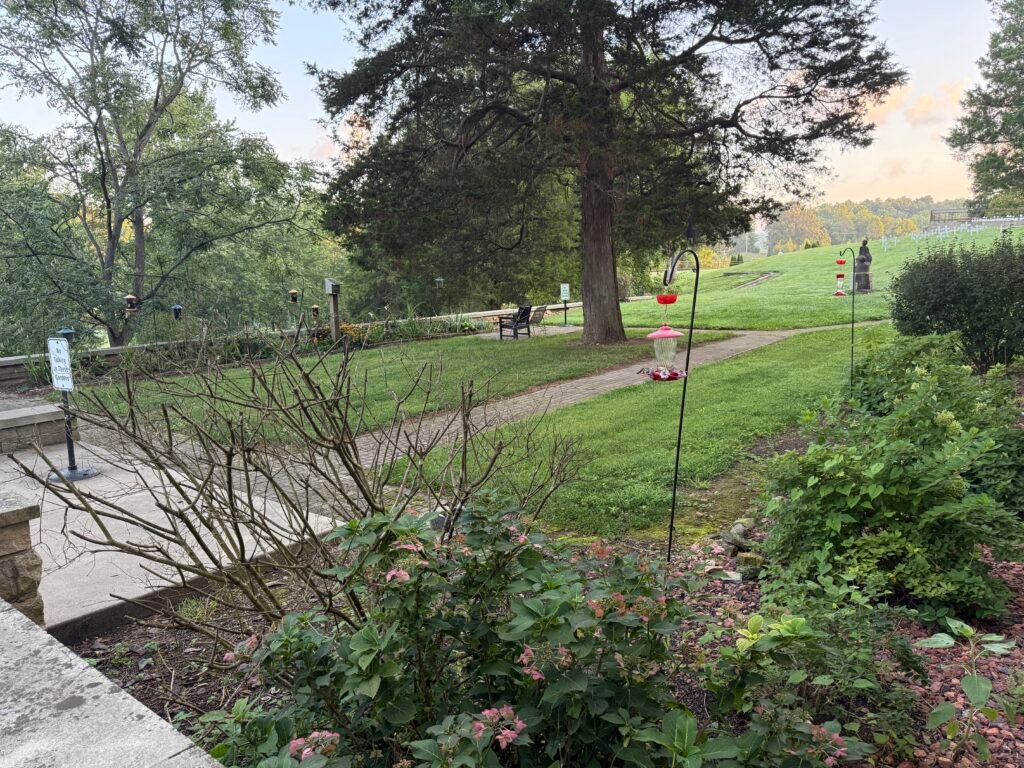
So I did. More than once—most often in a small garden near the retreat house, with bird feeders stocked in seed and sugar water both, and enough regular customers to outperform most television. Hummingbirds arrive several at a time and prove immediately that contemplative nonviolence hasn’t reached the hummingbird community; they share the feeder the way toddlers share a toy. One evening a cardinal took the seed feeder for a while after dark. A tiny woven nest tucked into a nearby tree turned out, almost certainly, to belong to one of the hummingbirds themselves—smaller than my palm, easy to miss entirely. Sweat bees kept me company one afternoon, small enough and curious enough to land on a shoe or a sleeve without much concern for personal space.

This became one of my favorite places to sit—morning with something to drink, evening with a book. Every time I sat, there were visitors like these that reminded me why I was here.
The one genuine nuisance showed up after dark. My last night, reading Merton in the garden after Compline, I was run off by an unusually insistent mosquito. The property has several springs and streams, mostly redirected underground through gullies and drainage, and I have to assume that’s where the local mosquito population makes its home. The Abbey seems to know it too—cans of Off are stocked at several of the exits, which tells you everything about how long that’s been a known problem.
A Room, a Bed, and Not Much Else
The accommodations are exactly what you’d expect from a Trappist retreat house: clean, functional, austere. My room held a twin bed, a desk and chair, a nightstand, two lamps, a crucifix on the wall, and a private bathroom. That’s essentially the inventory.
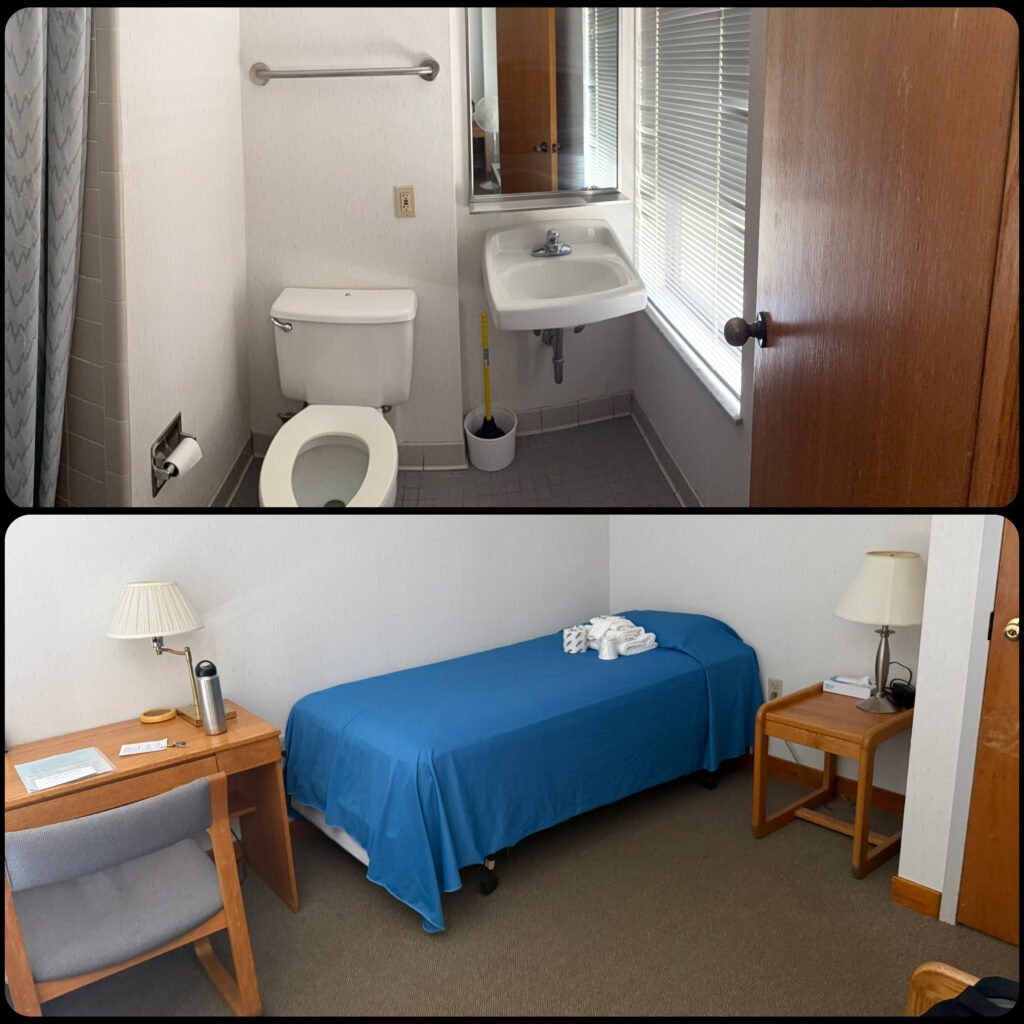
There’s air conditioning. There’s an elevator. The main guesthouse holds around thirty rooms, each with a private bath; a smaller wing inside the enclosure offers additional single rooms for those wanting something closer to the monastic environment itself.
The twin bed and I eventually reached an understanding. Barely. But the room was extraordinarily quiet at night, and there’s something genuinely freeing about a space with almost nothing in it demanding your attention.
Technology is a separate matter. Cellular reception was poor to nonexistent. Wi-Fi exists in the library—where, naturally, talking isn’t permitted. For an ordinary vacation, I’d call that an annoyance. Here, I started to suspect it was a feature.
About the Food
The monks prepare the meals themselves, and the monastic community doesn’t eat meat—though meat is served to guests several times a week. The Abbey is upfront that the kitchen can’t accommodate special diets and recommends bringing supplemental food if you need it.
Take that seriously.
Breakfast, every day of my stay, was almost entirely carbohydrate: oatmeal packets, small boxes of cereal, bread, bagels, canned fruit. Fresh bananas, apples, and oranges were the one consistently bright spot. Lunch—“dinner” on the monastery’s clock—redeemed things somewhat: chicken one day, beef sausage links the next, closer to a proper John Morrell-style link than anything I’d expected. I loaded up on both.
Still, if you eat low-carb, high-protein, or have any real dietary restriction, plan around it. By the end of the stay I was seriously contemplating a fast-food run into town purely for the protein.
There are sentences you don’t expect to write about a monastery.
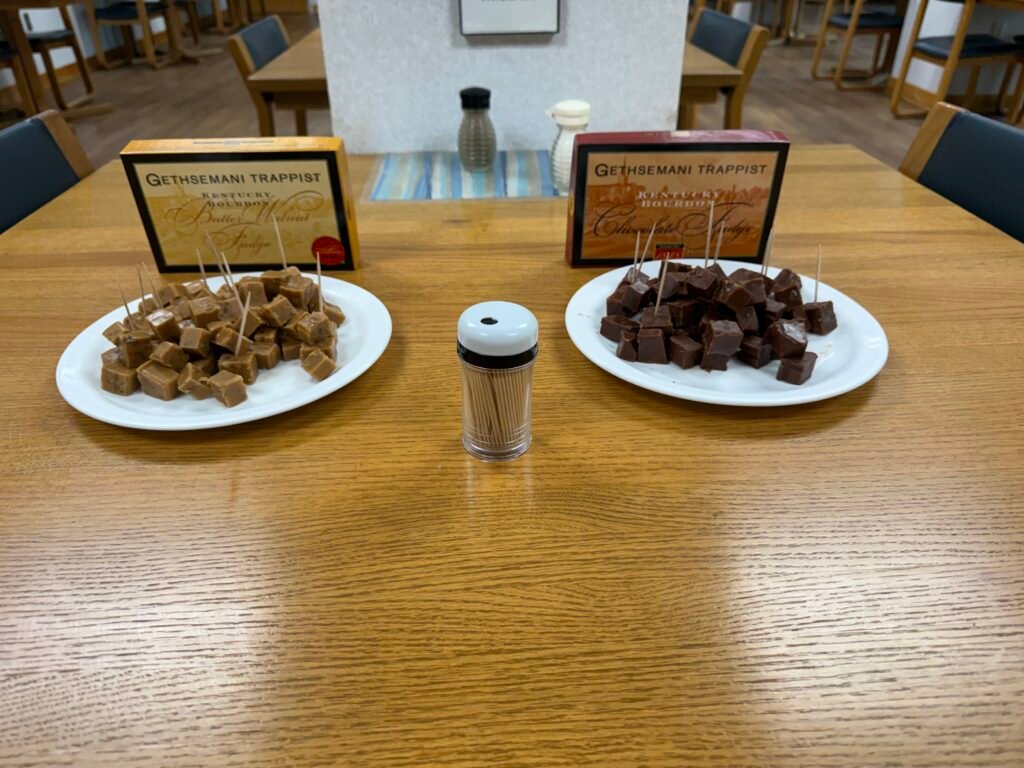
Then there’s the fudge—the Abbey’s other well-known export alongside its fruitcake, and it earns the reputation. Creamy, dense, genuinely melt-in-your-mouth. This is Kentucky. If bourbon can’t somehow be worked into monastic life, something has gone wrong with the Commonwealth. I may have eaten a few extra pieces. Shhh….
Fr. Louis
You can’t write seriously about Gethsemani without Thomas Merton, though the Abbey itself seems determined not to become a Merton theme park. That restraint is appropriate, and it’s everywhere once you notice it.
Merton entered Gethsemani on December 10, 1941, taking the name Fr. Louis. The Seven Storey Mountain, his 1948 autobiography, became an unlikely bestseller and made a reluctant celebrity out of a man who’d entered a monastery partly to disappear. Over the following decades he wrote on contemplation, race, nuclear war, nonviolence, and eventually interfaith dialogue, becoming one of the most influential American Catholic writers of the century—while spending much of that same period wanting more solitude than community life allowed him. He eventually got a hermitage on the grounds; it’s still there, still used for private retreats, and closed to visitors.
His Order had spent years refusing him permission to travel; in 1968 they finally relented, sending him to Asia to meet with Buddhist and Hindu monastic leaders on the subject of contemplative life across traditions. In November, in Dharamsala, India, he spent three long private conversations with the Dalai Lama—both men later described the meeting as significant, a rare point of real contact between Christian and Tibetan Buddhist monasticism. A month later, near Bangkok, Merton delivered a lecture on Marxism and monastic life to a conference of Christian and Asian monks. That afternoon, back in his room after a shower, he was electrocuted by a faulty floor fan. He was fifty-three.
He died on December 10, 1968—twenty-seven years to the day after he entered Gethsemani—and was later buried on the monastery grounds. Trappist tradition typically forgoes a casket altogether: a monk is washed, wrapped in his habit and cowl, carried on an open bier, and lowered directly into the earth. Given that Merton died abroad and his body had to be flown home, his arrangements necessarily involved some differences from the ordinary Trappist burial—one last irony in the life of a man who spent decades trying to disappear into the same plain anonymity as everyone else in that cemetery.
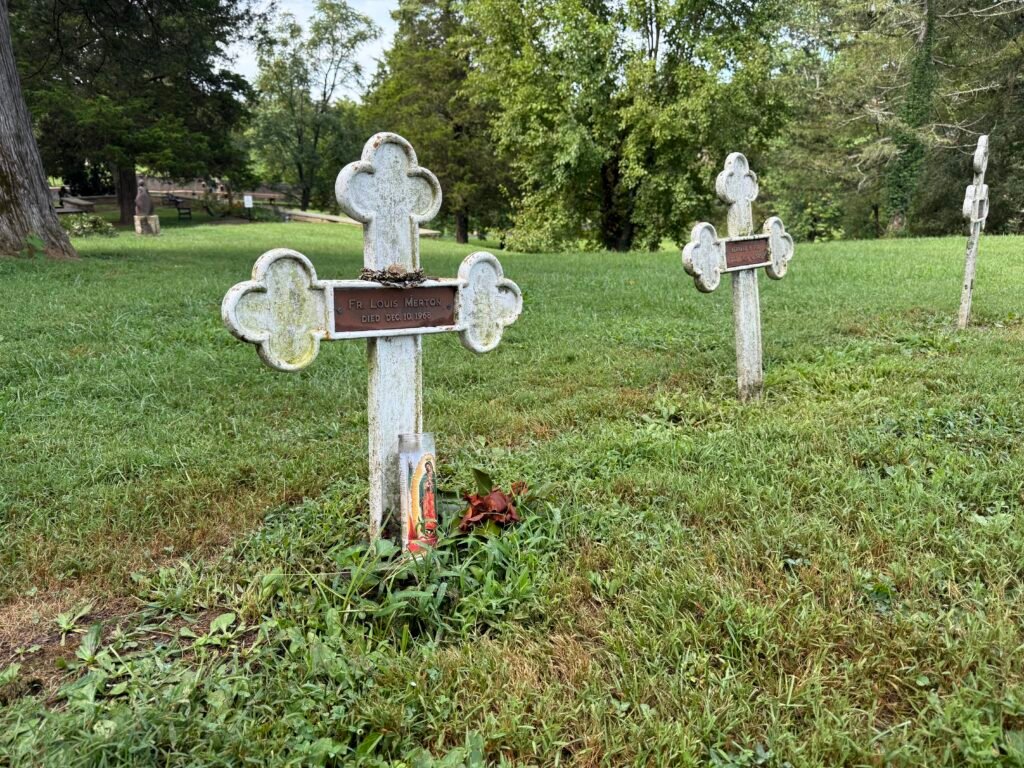
You can visit the grave. The trick is finding it.
There’s no map to it, no brochure, no plaque anywhere pointing the way. The gift shop has a Merton section. The library has a Merton section. That’s the entirety of the Abbey’s acknowledgment that one of the most influential Catholic writers of the twentieth century is buried on the grounds. I ended up walking the cemetery marker by marker until I found him—no shortcut, no signage, just reading crosses until the right name turned up.

For anyone who wants the actual directions: exit the retreatant dining room into the garden, turn right, and walk up the hill toward the monks’ cemetery. Look for the last full row just past a tree nearest the building.
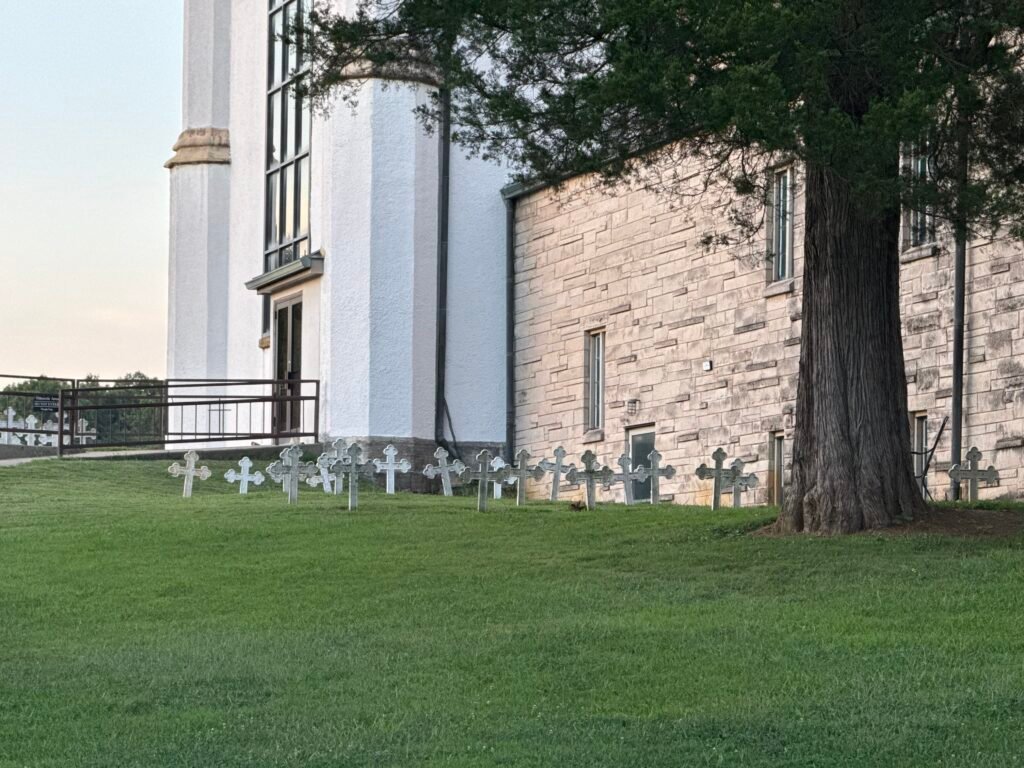
I wasn’t the only one interested in finding it. A couple also there on retreat cornered me in the lobby—one of the few places speaking is actually permitted—and asked, without much preamble, whether I’d found it yet. By then I had. I gave them directions and showed them a picture on my phone. I suspect the copy of New Seeds of Contemplation I was carrying had marked me as someone who’d know.
Fr. Louis Merton—Died Dec. 10, 1968.
That’s the entire inscription. No enclosure, no statue, nothing setting him apart from the row he’s buried in. And yet the marker rarely sits bare—rosaries, pens, small flowers, the same sort of quiet offerings you’d find at any grave people actually make a point of visiting. Merton spent much of his religious life wrestling openly with ego, obedience, solitude, and the problem of his own growing fame—one of the most influential Catholic contemplatives of the last century, and also a man who was, by every honest account, complicated: self-aware but ambitious, humble in doctrine but not always in temperament, famously contradictory. Death seems to have settled at least the geography of the question. Whatever the world made of Thomas Merton, Gethsemani buried Fr. Louis—and treats him, in the ground, exactly the way it treats everyone else out there.
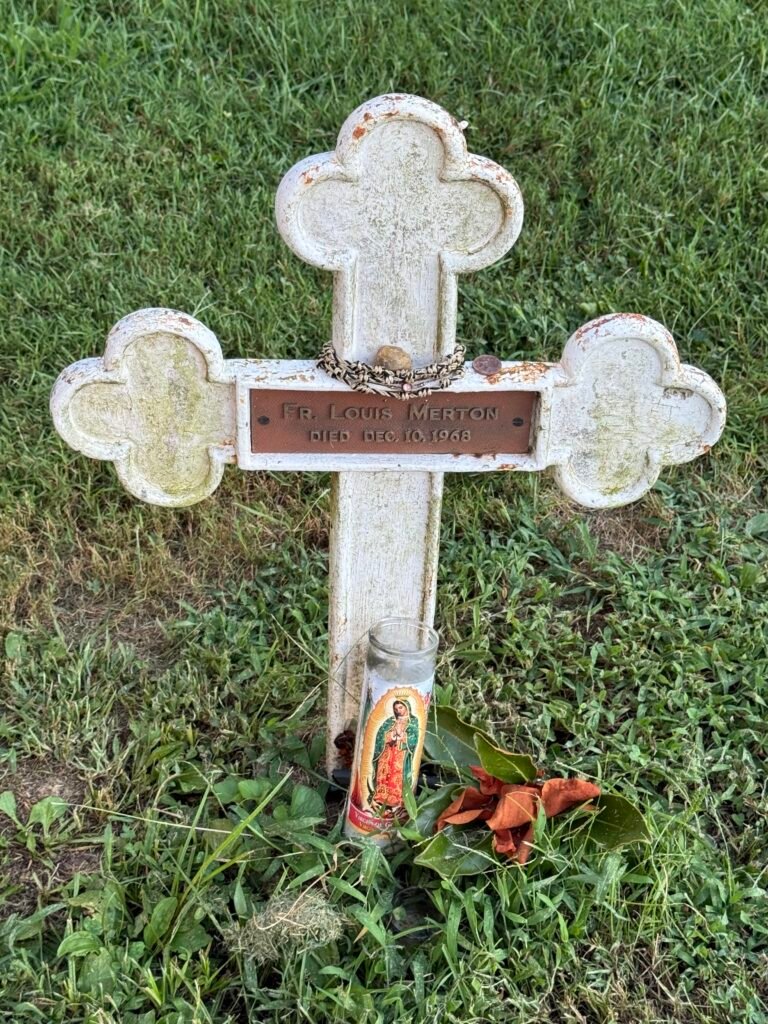
I stood over the cross for a minute before I left. You did well, Father Louis, I told him. Very well. Thank you.
There’s something almost perfect about a resting place that plain for a man who spent so much of his life trying to disappear.
If you want to start where I did, The Seven Storey Mountain is the obvious entry point—his own account of arriving here in the first place.
The Monks You Don’t Meet
One thing worth understanding before you go: a retreat here doesn’t mean spending your days around Trappist monks. The enclosure is real. Monks occupy their side of the church; retreatants occupy theirs. Most of the monastery is off-limits, and there are no tours through the monastic quarters.
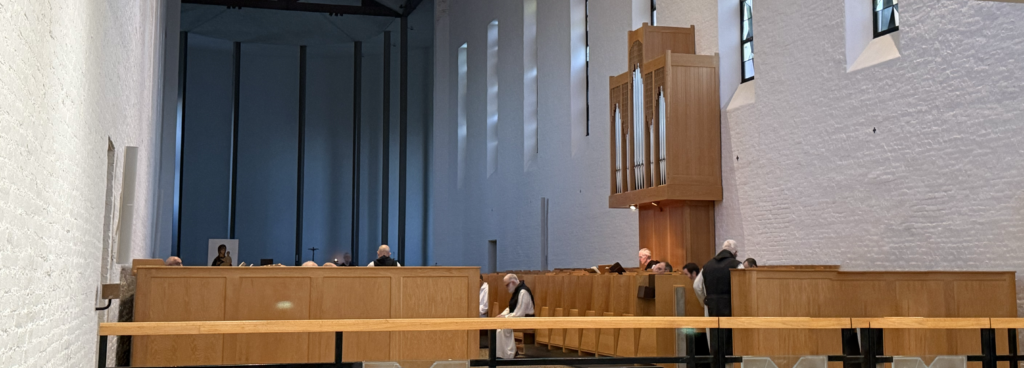
Access, for a retreatant, mostly runs through two people: the guest master and the chaplain.
My guest master was Fr. Carlos Rodriguez, originally from the Philippines, who’s held the role for years and clearly has the temperament for it—warm, unhurried, the sort of presence that makes an unfamiliar and demanding schedule feel navigable rather than intimidating. It was Fr. Carlos, one evening, who offered the piece of advice that ended up following me around for the rest of the stay: stop worrying so much about whether you love God enough. Let Him love you.
The chaplain, Dom Timothy Kelly, is ninety years old and one of the last monks still at Gethsemani with actual memories of Thomas Merton. He’s lived nearly the whole arc of the Abbey’s modern history. He entered in 1958, made solemn vows in 1963, was ordained in 1965, and was in Rome during the Second Vatican Council. He became abbot in 1973 at thirty-seven and served until 2000. He tried to retire after that and instead was made Procurator General, the Order’s principal liaison to the Vatican, a post he held in Rome for more than twenty years. He came home a few years ago meaning to actually retire this time.
He’s the chaplain now instead.
Mention Merton’s name to him and something shifts—Dom Timothy’s whole face changes, and the stories start coming, unhurried and clearly well-worn from being told before, though never in a way that feels rehearsed. Talking with him is as close as most retreatants will get to firsthand memory of the man himself.
At ninety, he’s a genuine repository of institutional memory in a way nobody else there is quite positioned to be. Between him and Fr. Carlos, that’s essentially the whole of direct monk contact a retreatant gets—which, if you came expecting long conversations with the community, is worth knowing going in. It isn’t that kind of retreat. It was never going to be.
The Gift Shop
No pilgrimage ends without someone selling you something, and the Trappists know this as well as anyone.
To be fair, manual labor has always been part of Benedictine tradition, and Gethsemani supports itself substantially through the products of that labor—fruitcake and bourbon fudge chief among them. Alongside Gethsemani’s own products, the shop carries goods from other monastic communities: jams and jellies from the Trappist monks of St. Joseph’s Abbey in Spencer, Massachusetts, and cookies and Prayerful Pretzels baked by the Benedictine Sisters of Monastery Immaculate Conception in Ferdinand, Indiana, among other things. The Welcome Center also carries books, icons, rosaries, crosses, and a genuinely tasteful selection of religious gifts.

And then there’s the Merton section. An entire bookcase, plus a table that’s overflowed onto a second one—biographies, essay collections, the Merton Encyclopedia, correspondence, art. If you go in intending to buy one book for the drive home, budget for more.
I speak from experience.
Across the Road
If the buildings hold the silence, the land beyond them holds the space. Roughly two square miles west of Highway 247 have belonged to the Abbey since its earliest days, most of it deeded by Bishop Martin John Spalding of Louisville in 1851. It’s open to visitors, and the Abbey posts a real trail map at the entrance—the kind with actual mileages and named landmarks, not a vague sketch. From the trailhead: 0.7 miles to the statues, 0.7 to Dom Frederic’s Lake, a mile to the Stone House shelter, two miles out to the old Hanekamp homestead.
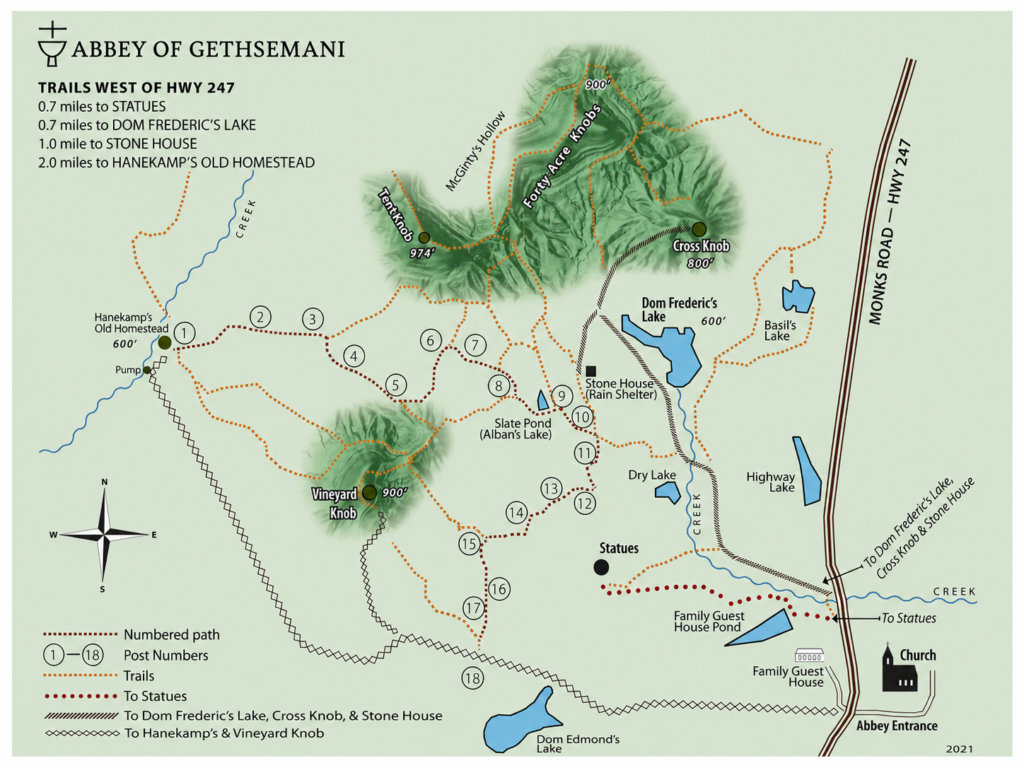
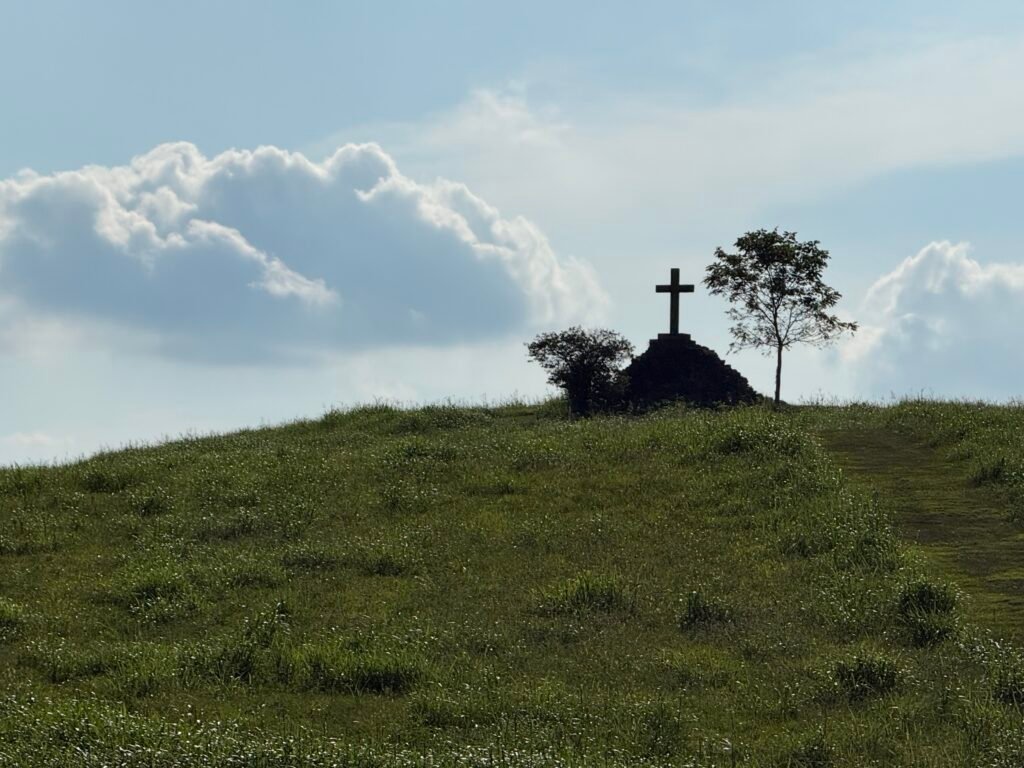
The names carry their own small histories. Dom Frederic’s Lake, built in 1938, is named for Dom Frederic Dunne, abbot from 1935 to 1948, and served as the Abbey’s main water supply until the 1990s. The knobs themselves—Forty-Acre Knobs, Tent Knob at 974 feet, Vineyard Knob at 900, Cross Knob at 800—take their names from failed vineyards, old fire towers, and a cross moved from the church’s original steeple during a 1960s renovation. The current aluminum cross on Cross Knob went up in 2020. The Hanekamp homestead marks where a German immigrant named Herman Hanekamp lived alone as a lay hermit from around 1912 into the 1950s, maintaining contact with the monks the whole time; when he died, he left the Abbey about a hundred acres of unspoiled woodland.
And near the trailhead stands a sculpture group, The Garden of Gethsemani, by Walker Hancock—commissioned in 1964 for a church in Massachusetts, with a second casting given to the Abbey in 1966 in memory of Jonathan Daniels, a young Episcopal seminarian shot and killed in Hayneville, Alabama, in August 1965 while shielding seventeen-year-old Ruby Sales from a shotgun blast meant for her. It’s the kind of detail you could walk right past without knowing what you’re looking at. Gethsemani has quite a few of those.
The trails themselves are real enough to show up in hiking apps—AllTrails included—which surprised me a little the first time I checked. A Trappist monastery, mapped and rated by the same app people use for weekend day hikes.
I didn’t make it out to the knobs this trip. Next time.
What You Actually Come Here For
None of that quite explains the place. Not the history, not Merton, not the trails or the offices or the two monks you actually get to meet.
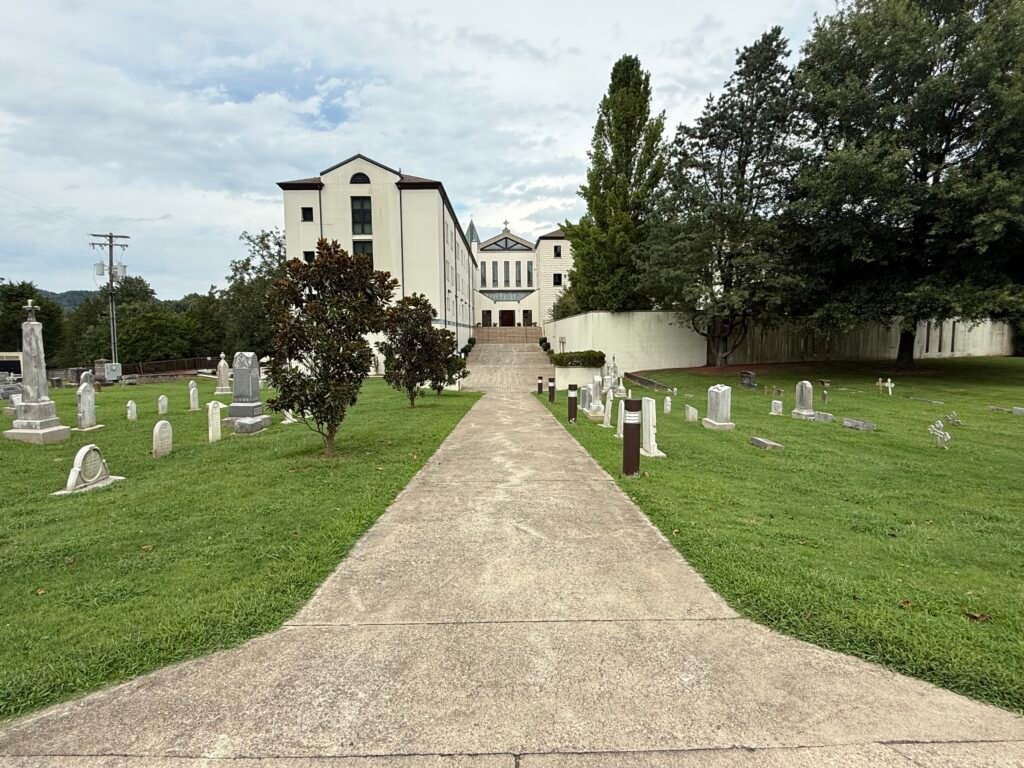
What Gethsemani provides, more than anything else, is absence. For a few days, almost nothing needs very much from you. The phone barely works. Nobody expects conversation. Meals happen at fixed times. Bells tell you when the offices begin, and you can go to all of them or very few—the retreat itself is deliberately unstructured, and nobody hands you a curriculum or checks whether you’re doing contemplation correctly.
You can walk. You can read. You can sit beneath a grove of maples waiting for the gift shop to open and listen to cicadas working themselves into a frenzy. Or you can simply sit, which sounds trivial until you realize how rarely you actually do it.
Somewhere around my second day, sitting under those same trees, a thought arrived on its own: what if I just stayed here? I found myself doing actual math—how long provisions would last, whether I really needed to leave on schedule, how long a person could go on being nowhere in particular, answerable to no one.
I had no interest in becoming a monk. What appealed to me was simply not leaving. Those are different things, and by the end of the stay I understood the difference a good deal better than when I arrived.
Leaving
Eventually the things that had made the retreat useful started telling me it was time to go. I wanted a real keyboard. I wanted my monitors. I wanted reliable internet, and food with fewer carbohydrates than the average county fair.
Mostly, I wanted to write. Actually write.
That wasn’t a failure of the retreat. It was the retreat finishing its job. Gethsemani gave me a place to receive something. Home is where I do the producing.
Solitude, it turns out, isn’t the same thing as withdrawal. I don’t need to disappear from the world to find what this place gave me. I need places where the world occasionally stops demanding my immediate participation in it—and Gethsemani builds that condition better than almost anywhere I’ve been. Bells replace notifications. Silence replaces chatter. Walking replaces rushing. Nothing dramatic happens, which leaves plenty of room for whatever’s been waiting underneath the drama to finally get a word in.
I didn’t stay.
But I understand a lot better now why, for a while, I wanted to.
Practical Notes
The Abbey of Gethsemani sits near Trappist, Kentucky, south of Bardstown. Silent retreats begin Monday or Friday; minimum stays run three nights on weekdays, two on weekends. The retreat house operates on freewill offering rather than a fixed rate, and includes lodging, three daily meals, and access to the public retreat grounds and trail property—the monastic enclosure itself remains off-limits. Day visitors can attend the liturgy and walk the public grounds without a reservation. Roughly two square miles of trails west of the monastery, complete with a posted map, are open to hikers—and yes, they’re on AllTrails.
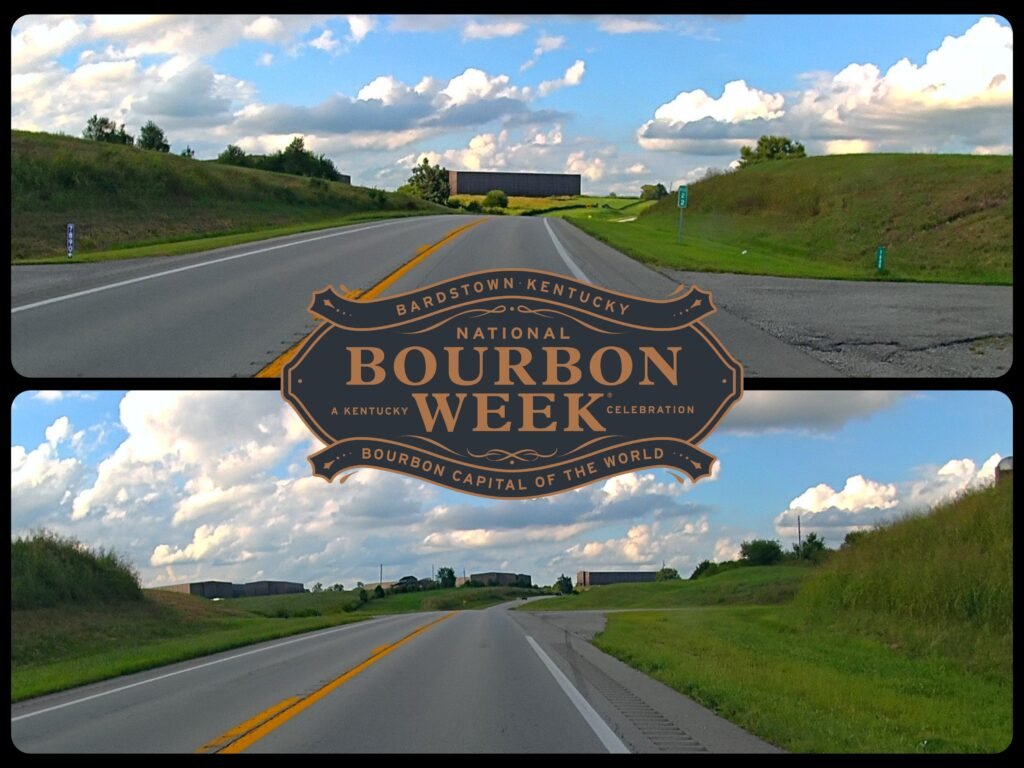
Before or after your stay, it’s worth the extra twenty minutes to drive through Bardstown itself—bourbon capital of the world, by its own reasonable claim, with distilleries in every direction, tasting rooms, tour buses, and an annual bourbon festival that takes over downtown each fall.
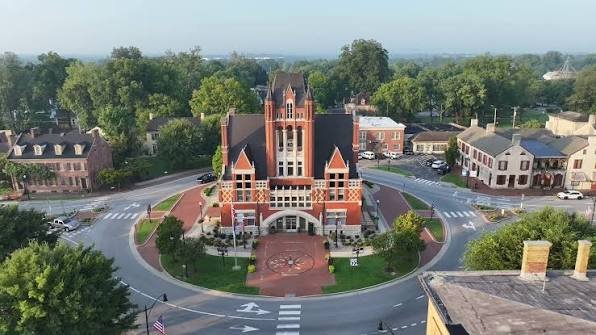
I would also bestow upon them, somewhat more tongue-in-cheek, the title of roundabout capital of the world, the crown jewel being a full traffic circle that surrounds the historic Old Nelson County Courthouse dead center in town—an entire government building on its own island, cars looping around it in every direction. Not the sort of civic engineering you expect in a small Kentucky town, and somehow it works. The town itself is walkable, full of local shops, and hasn’t been hollowed out by a bypass. Worth a slow afternoon on either end of the retreat, bourbon interest or not.
Author’s Note: This retreat, and the piece above, gave rise to a series I hadn’t planned on writing before I arrived—starting with What If I Just Stayed Here? on Many Lamps, One Flame.

Discover more from Rogue Wayfarer
Subscribe to get the latest posts sent to your email.