
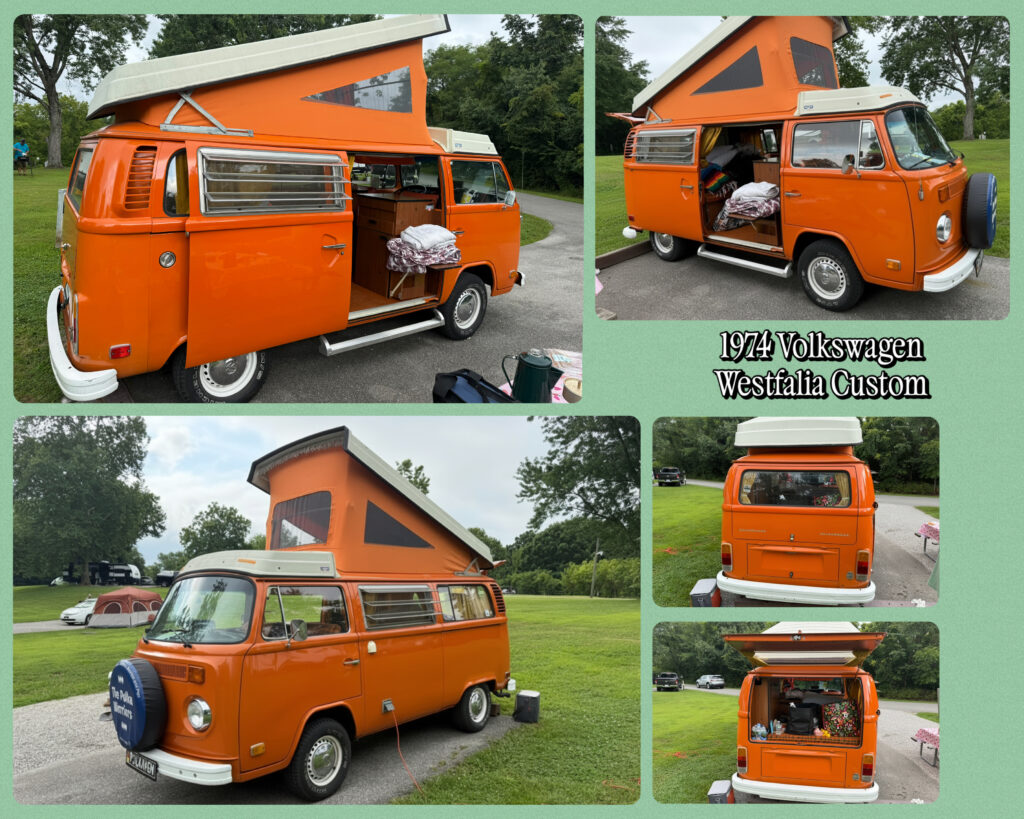
Big Bone Lick State Park sits in northern Kentucky, named for the mammoth and mastodon bones early settlers pulled out of the salt springs there. I’d been camped since Friday. Sunday morning I went out for a walk and came across a van that stopped me cold—a 1974 Volkswagen Custom Westfalia, restored down to the chrome, pop-top raised, curtains pulled back to let the morning in.
Jim and Elise were breaking camp, loading the last of it into the van for the drive home. Their maiden voyage, Jim told me—bought from a seller in California, shipped east, a few months of bodywork to chase down some rust before it was road-ready. He walked me through it the way people walk you through something they’re proud of: the fold-down bed, the cabinets that hid a small stove, a water tank, and a freezer, all tucked in behind the driver/passenger seats. We talked long enough to find out he’s a software developer, same as me. Long enough for the conversation to wander somewhere heavier—Jim said the world doesn’t feel like a very hopeful place right now, especially for the young. Somewhere in that thread, he mentioned a philosopher whose writing had stuck with him. Something appropriate to the moment, he said.
Viktor Frankl.
I knew the name. I hadn’t expected to hear it standing next to a fifty-year-old camper van in a state park on a Sunday morning, in an impromptu conversation with a stranger packing up his van to go home.
Frankl was a psychiatrist in Vienna before the Nazis sent him to the camps—Theresienstadt, then Auschwitz, then Kaufering and Türkheim. He lost his wife, his parents, nearly everyone he loved. What he came out with, and later wrote down in Man’s Search for Meaning, wasn’t optimism in any sense of the word. It was an argument, made by someone who had earned the right to make it: that a person can be stripped of everything—home, family, health, freedom itself—and one thing still remains theirs to control.
The response to it.
I didn’t ask Jim why, out of everything, that was the name that came to mind. I didn’t need to. Some conversations don’t require you to trace the thread back to its source. They just land, and you recognize the shape of what you’ve been handed.
Two years ago I went into a hospital expecting to leave it in a body bag. That’s not dramatic phrasing—it’s what I understood the situation to be. I want to be precise about what that meant, because it wasn’t that I’d given up. I didn’t want to suffer through an ending that seemed, at that point, inevitable. There’s a difference, and it mattered to me then and matters to me now. Then a doctor told me I was not going to die, was a good candidate for a heart transplant, and that they believed they could keep me stable long enough to get me there. That was the whole conversation. Somewhere in the space of that sentence, something in me turned over.
I chose life.
I didn’t have Frankl’s language for it at the time. I have it now. The choosing wasn’t something that happened to me—it was something I did, in a small room, before I had a word more precise than stubborn to describe it.
That choosing hasn’t stopped being relevant. A 35-year relationship ended, not by anything I chose. I’m disabled now, in ways that reorganize a day before it’s begun. I don’t know what the next year looks like, let alone the next five—where I’ll be sleeping, or even what this life turns into. None of that is circumstance I selected. All of it is circumstance I get to answer.
Part of why I came out this weekend at all was Tisha b’Av—a day of mourning I’ve come to observe over the years, though I wasn’t raised to it. It’s the day that sits at the bottom of the Jewish calendar, built around grief that doesn’t fully resolve, that gets carried forward instead of closed out. I’d been sitting with it for several days and needed some time away to think it through, which is most of the reason I was at Big Bone Lick in the first place. So when a stranger, packing up to leave a campground, mentioned a philosopher who built his entire framework out of grief that doesn’t resolve either—I don’t think that’s coincidence in any mystical sense. I think it’s what happens when you go looking for something and someone hands it to you without your asking.
I don’t think Jim knew any of that. He was just a guy proud of his van, talking to another stranger on his way out of a state park, saying what was actually on his mind about the state of things. That’s the part I keep coming back to. He had no idea what he was handing me. He just happened to be standing there when I was ready to receive it.
That’s what I think I’m actually looking forward to over the next months and years on the road. Not the scenery, though I’ll take the scenery. Not the campgrounds, or the mileage, or the places I’ll finally get around to seeing.
It’s this. A van, a conversation about a world that doesn’t feel hopeful, and a name that had been waiting for the right moment.
Not the miles.
The conversations between them.

Discover more from Rogue Wayfarer
Subscribe to get the latest posts sent to your email.