
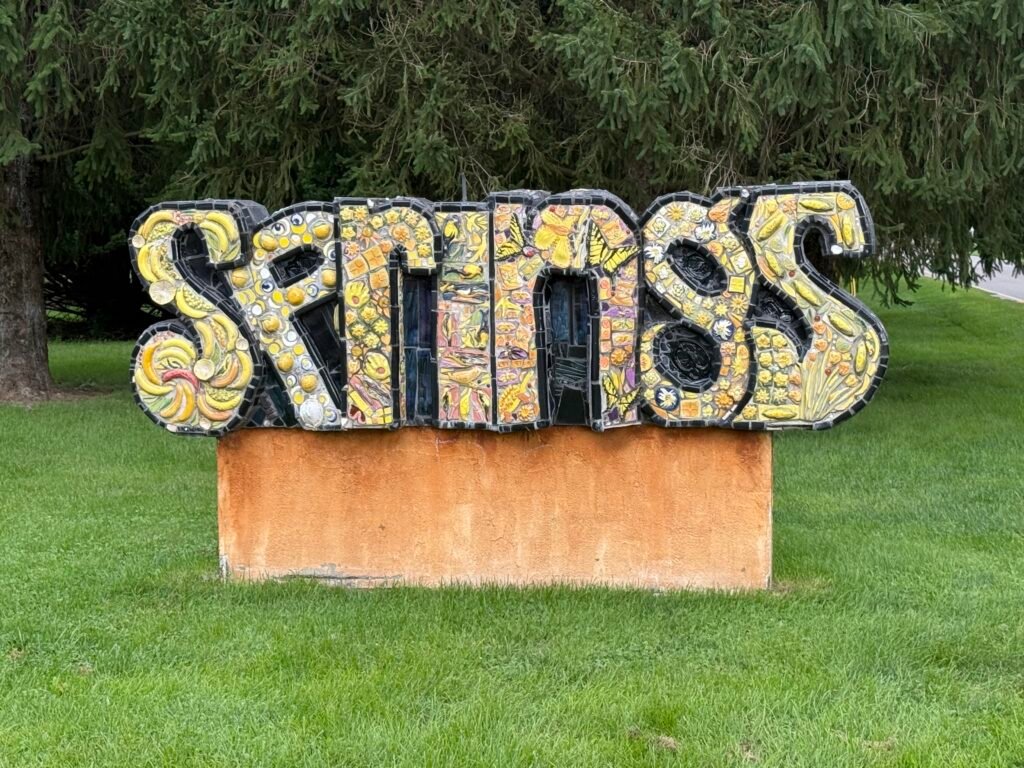
Thirty thousand people had filled these streets the day before. I couldn’t find a single trace of them.
I came into Yellow Springs early on a Sunday morning in June, the fourteenth, less than a day after the Street Fair had let out. I had missed it by one day. What I expected was wreckage—the flattened grass and stray cups and general hangover of a village of thirty-six hundred that had just absorbed a crowd eight times its own size. What I got was swept brick, open parking, and a town that appeared to have spent the previous day doing nothing in particular.
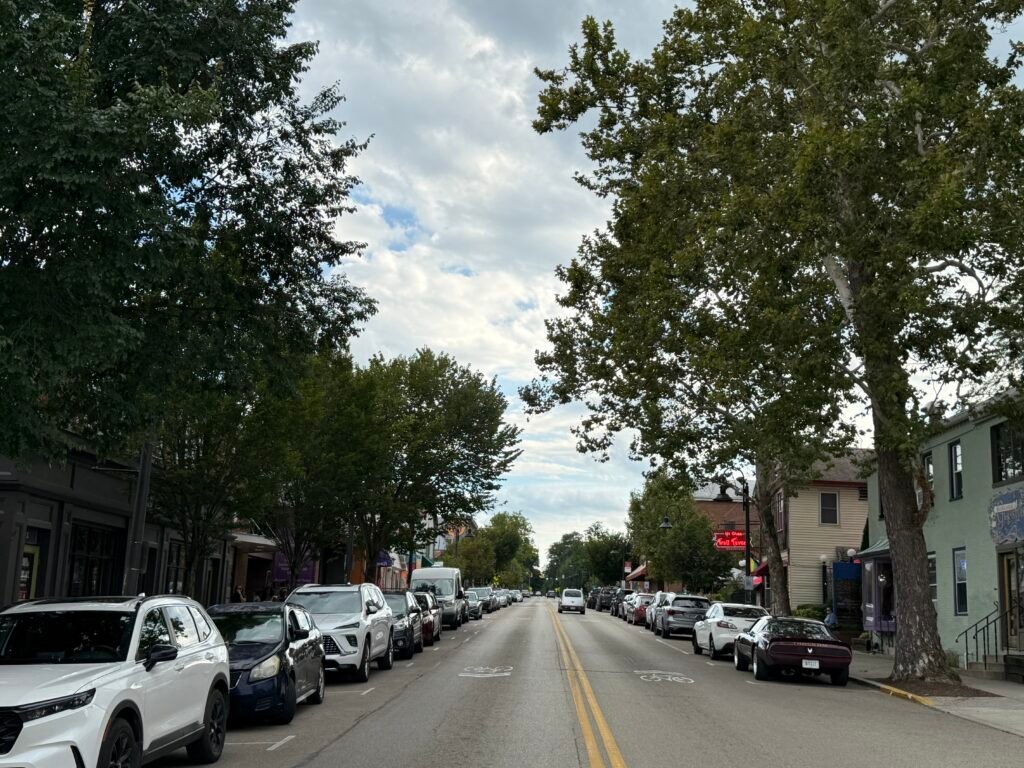
What Had Happened Here
The Yellow Springs Street Fair runs the second Saturday of June and the second Saturday of October, as it has for decades. This June it brought 170 vendor booths, 28 food vendors, and 16 entertainers playing at points around downtown, plus private lot owners opening their own property to handle the overflow. The Chamber’s post-event count came in around thirty thousand people, over an advance estimate of twenty-five. Parking runs out to Young’s Jersey Dairy, three miles up the road, with shuttles into town. It is, by any reasonable measure, the largest thing that happens here.
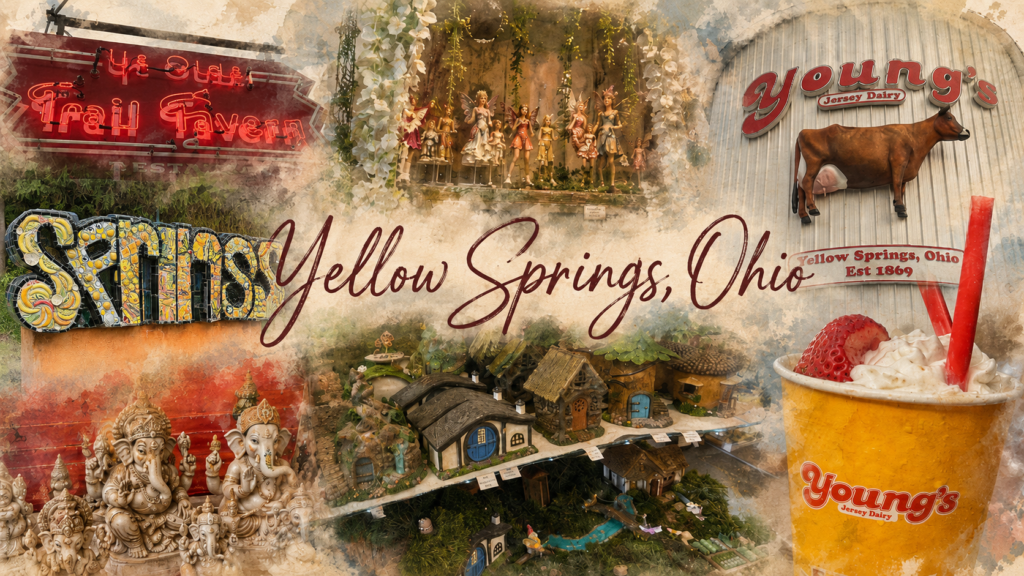
The founding is messier than the tourist version. Benjamin Whiteman and Lewis Davis platted lots around the spring in about 1820 and called the place Ludlow. In 1825 roughly a hundred families, taken with Robert Owen’s ideas and the experiment underway at New Harmony, built a communal settlement here—one big shared building, shared labor, shared proceeds. It lasted about a year. Some of them wanted the benefits without the work, a hard winter did the rest, and it came apart. Elisha Mills, a Connecticut lawyer by way of Cincinnati, bought the land around the spring the following year and built a hotel on the theory that people would pay to come drink the water. His son William, born in 1822, is the one generally called the village’s founder: he got the Little Miami Railroad routed through here in 1846 rather than through Clifton, talked the college into siting itself here in 1850, and platted and registered “Yellow Springs” in 1853.
The name comes from the spring itself, out in what is now Glen Helen, iron-rich enough to stain the rock a rusty yellow and long believed to cure whatever you had.
The rest of the history is less quaint and considerably more interesting. Antioch College opened its doors in 1852 with Horace Mann as its first president, admitting women and Black students on equal terms at a time when almost nowhere did, and putting a woman on the faculty at the same rank and pay as her male colleagues—a first in the country. In 1862 about thirty people who had escaped slavery in Virginia arrived here with the abolitionist minister Moncure Conway, whose own father had enslaved them. Wheeling Gaunt came in the same decade, a man who had bought his own freedom and then his wife’s, and who became one of the wealthiest Black landowners in the county. He left land to the village on the condition that the rent be used to buy flour for its widows. The village still delivers flour and sugar to them every Christmas.
So when people describe Yellow Springs as a progressive town, they are describing something with a two-hundred-year foundation under it rather than a recent affectation. It shows in who walks the sidewalks and who runs the storefronts, and it is worn lightly enough that nobody appears to be making a point of it. The Chamber of Commerce will sell you the walkable-village version. The village’s own record is better.
The First Witness
I was in Bonadies Glass Studio when two men decided I needed to know what I had missed.
They gave me twenty minutes. Wall-to-wall on Xenia, you couldn’t move. The line at every food booth. Music going in four directions at once, and the particular density of the air when that many people are packed into six blocks. They come every year. They said so twice. Late twenties, maybe early thirties—though at this point a great many people are younger than I am—and they were not selling me anything and were not from the Chamber. They had simply spent Saturday enjoying themselves and had not finished talking about it.
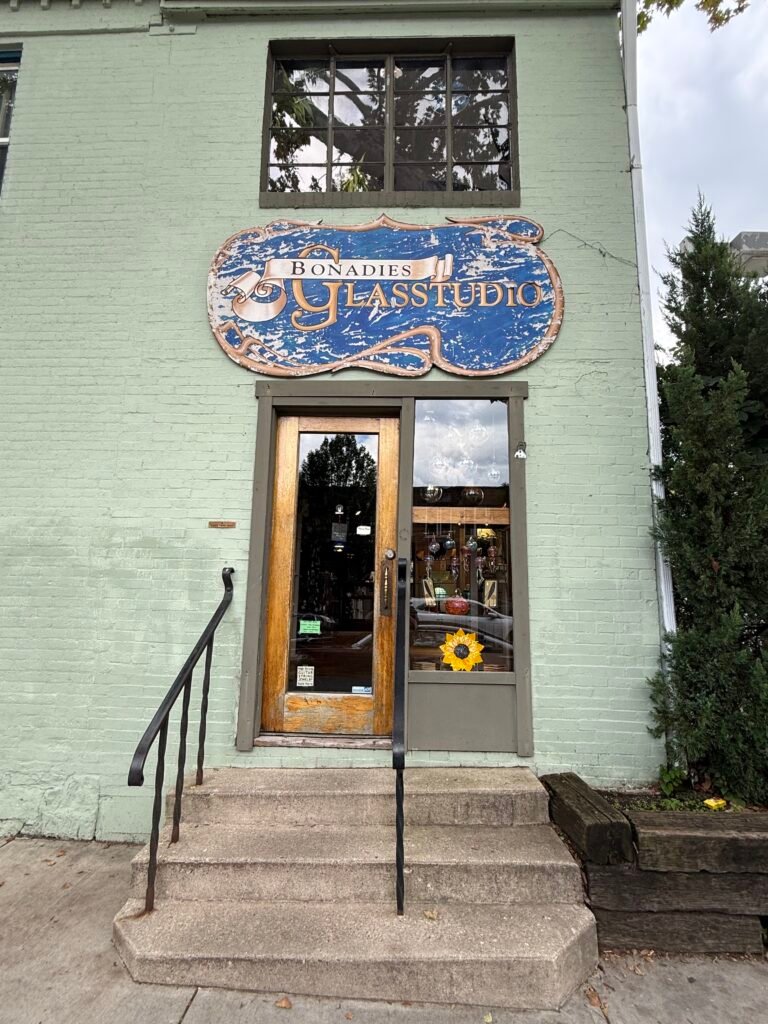
The whole time, I was looking past them through the front window at an empty street.
Little Fairy Garden
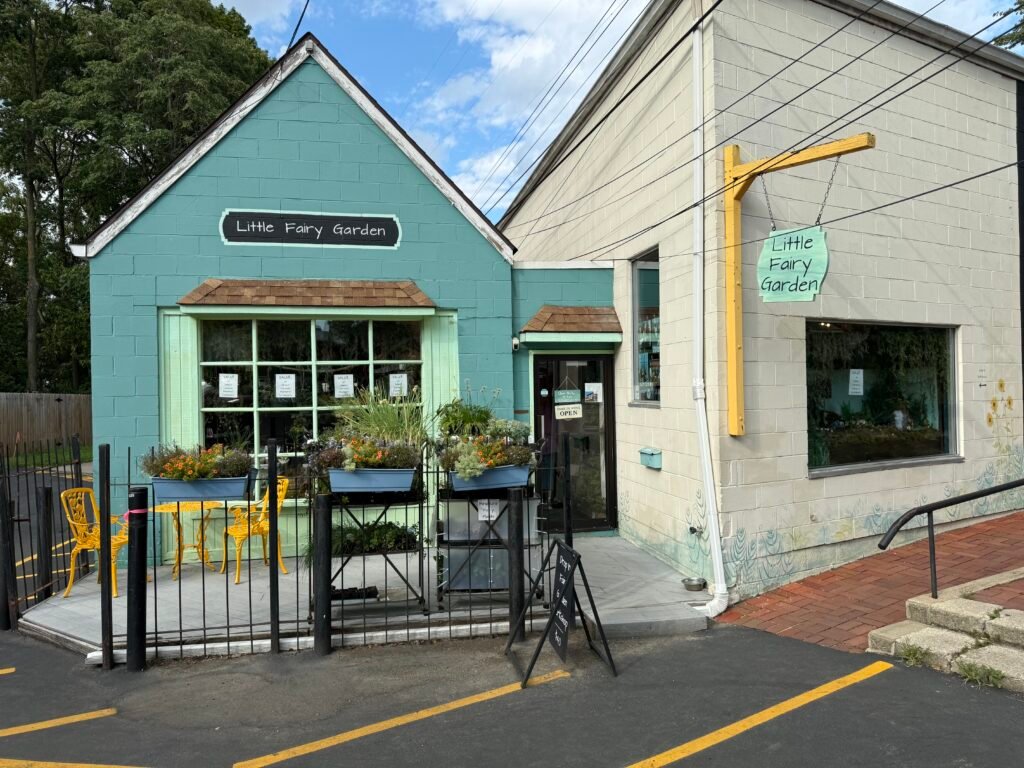
A few doors up, at 224 Xenia, is a shop that sells nothing but miniature villages.
You have to work slightly to get into it. You step off the King’s Yard strip, take a short ramp and a set of stairs, come around the far side of the building, and enter at the corner—an approach odd enough that you would never stumble in. Which suits it. The shop is apart from the rest of the block in more than address.
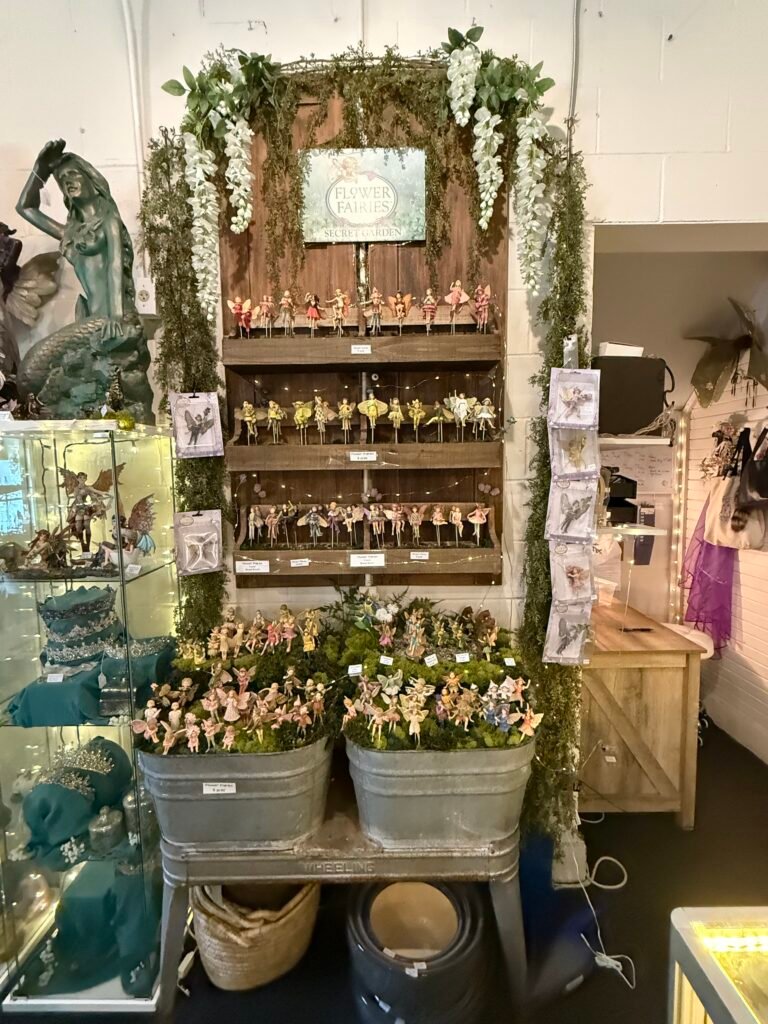
I have seen Christmas village displays. This was not that. Little Fairy Garden runs three tiers of glass shelving stocked with fairy houses—thatched cottages, tree houses with staircases carved into the trunk, a stone bungalow with a waterfall down one side, a mushroom-capped hut, a face carved into an oak that watches you back. Priced individually, hand-lettered tags, thirty to seventy dollars apiece. A retro camper trailer in cream and avocado green, thirty-two ninety-five. Moss, gravel paths, tiny stone retaining walls, live plants for anyone building the thing at home. There’s a room in back where you can assemble one on the spot.
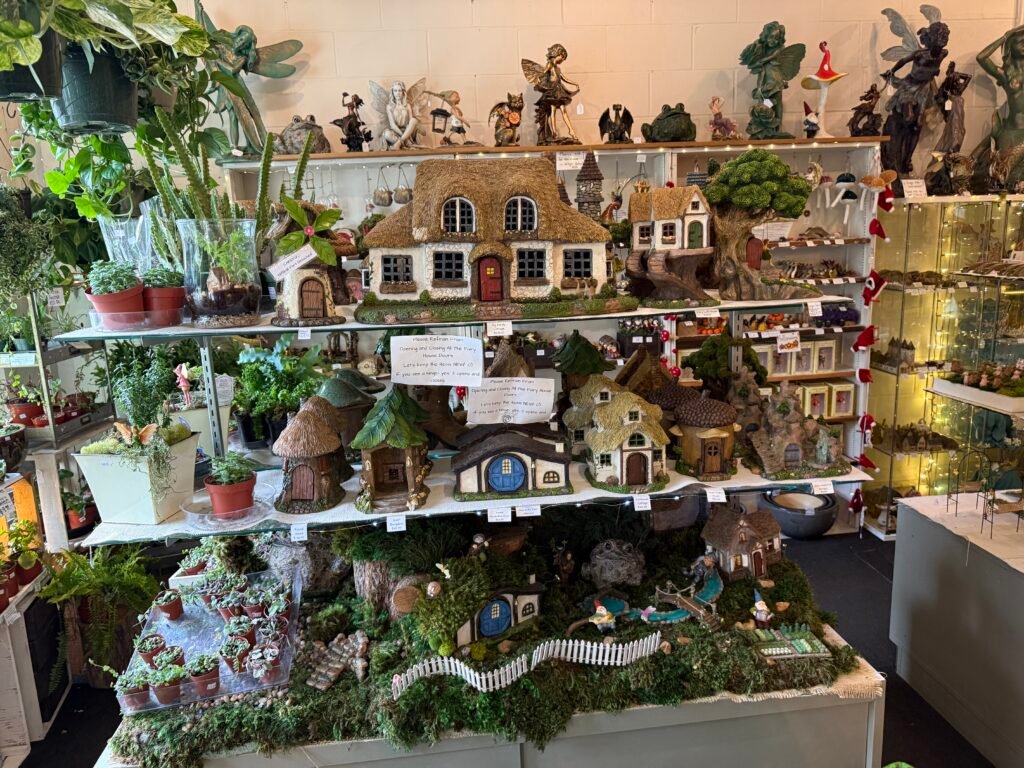
Taped to the shelves, in the same handwriting as the price tags:
Please Refrain From Opening and Closing All The Fairy House Doors. Let’s keep the items NEW! If you see a hinge—yes, it opens and closes.
I read that sign. I then opened the door on a large and expensive fairy house, because I wanted to see what was inside, and I was told in no uncertain terms not to do that. Fair enough. It’s a hinge. It opens.
You could build an entire settlement out of that shop. People clearly do. And the whole premise of the place—that the most satisfying thing you can make is a small, permanent, well-tended little home with a door that latches—stood out to me for reasons I did not examine at the time.
Asanda Imports
Three of the shops in this village import from Asia. Asanda, Tibet Bazaar, Pangea Trading Company. Between them they carry more incense than a town of thirty-six hundred people could reasonably burn.
At Asanda, two women walked me through where the stock comes from. Some of it arrives the ordinary way. Some of it they bring back themselves, in luggage, after a trip—Thailand, I think, though I wouldn’t swear to it now. The part I hadn’t expected was the compliance conversation. Thailand restricts the export of Buddha images, they told me, and the restriction runs on the likeness itself rather than on the age or the value of the object. Nothing on those shelves was an antiquity. It didn’t need to be. A newly cast Buddha is a paperwork problem, and they knew the paperwork, which is not something I expected to find behind the counter of a gift shop in a village this size.
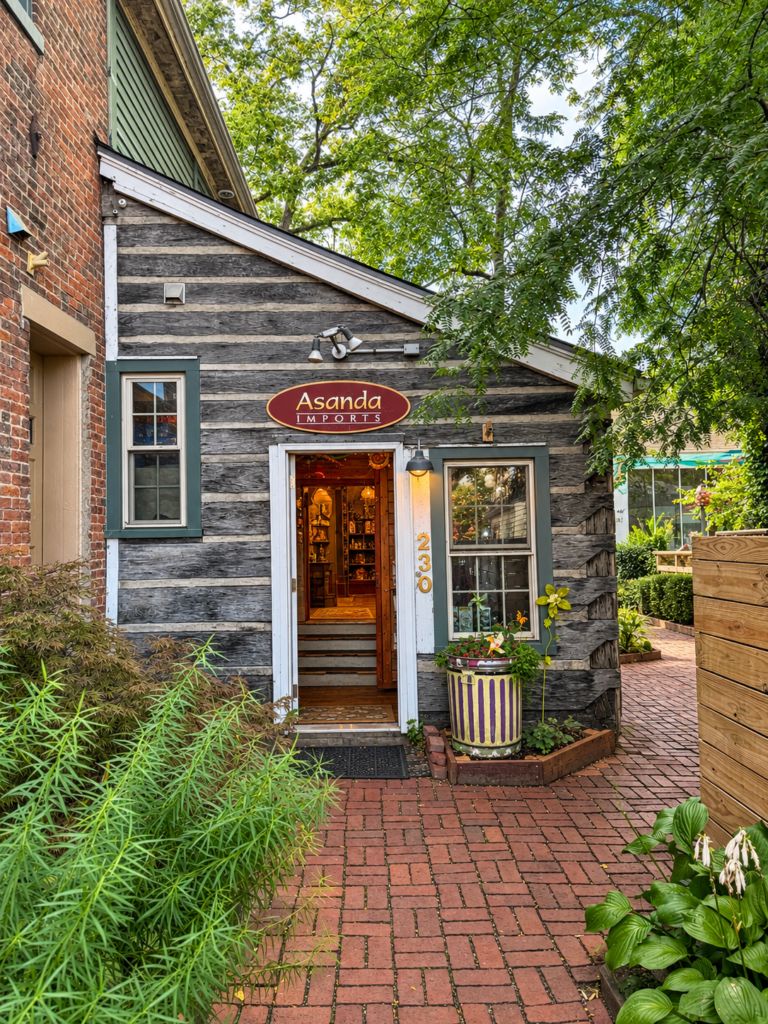
There was a seated Buddha in there, three or four feet, that I wanted more than I want most things. I did not have anywhere to put it.
And in all three shops, on every shelf, in every size from keychain to knee-high: Ganesha. The elephant-headed one. Cast in resin, carved in wood, painted in brass and gilt. Tibet Bazaar in particular was thick with him.
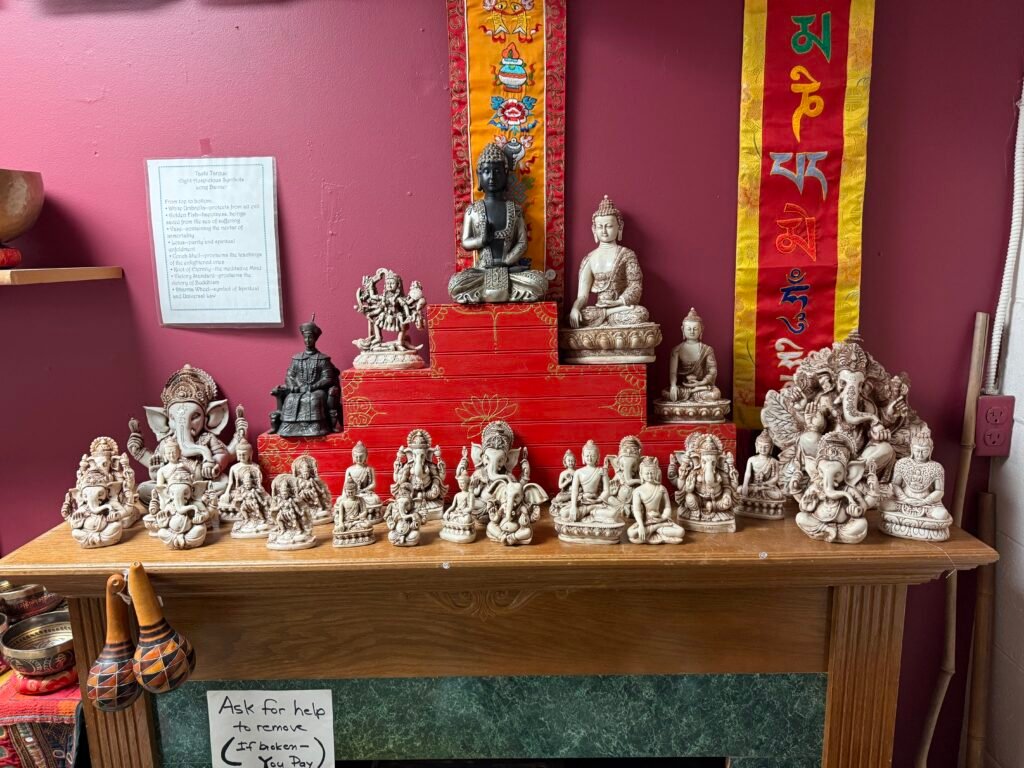
I noticed the abundance. I noted it the way you note that a shop has a lot of candles. Then I moved on.
Ye Olde Trail Tavern
Lunch at 228 Xenia, in a building billed as the oldest tavern in Ohio.
The back of it is hand-hewn log, put up in 1827 by Elisha Mills and his son William. It was called Elisha’s Tavern then, and it was the only structure standing on this stretch of what is now Route 68. The front section came later, moved onto the lot in the 1840s by Franz Martin Hafner, a German immigrant who came over in 1832, worked as a baker and a groundskeeper, married a local woman, sat on the village council for thirty years, and whose family held the building into the 1950s. When the current owners bought the place in 2017 and found Hafner in the microfilm at the Antiochiana library, they gave the kitchen a German menu. That is why an Ohio log cabin from the Jackson administration serves currywurst.
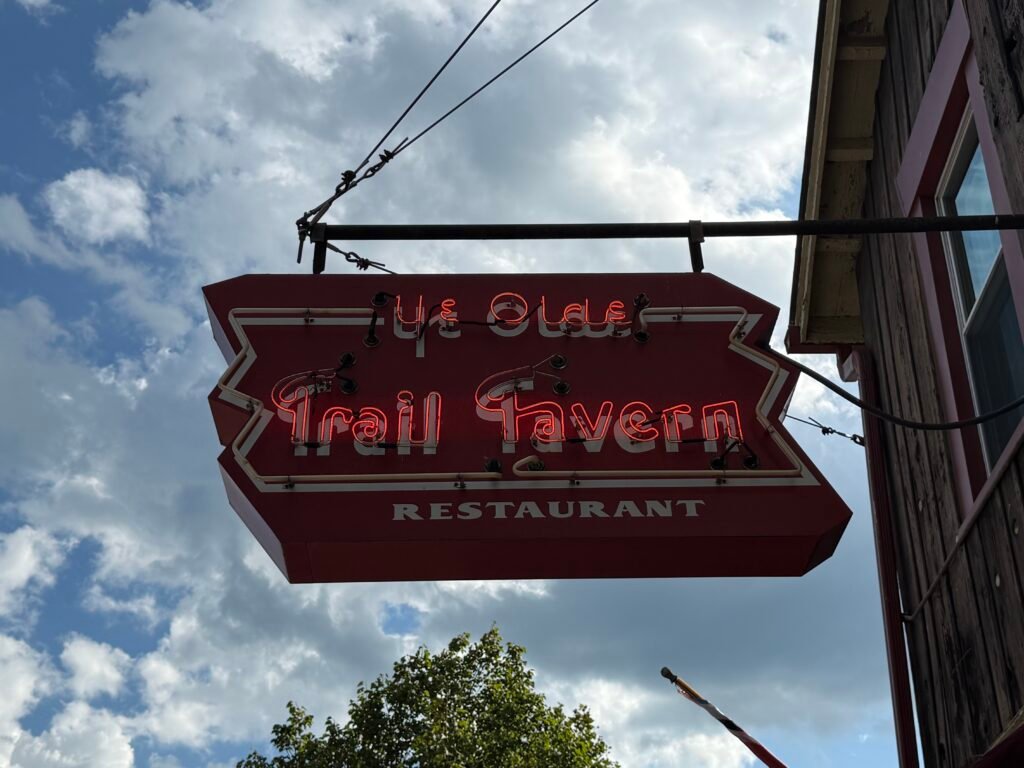
From the street it reads as a small dark bar. Inside it keeps going—rooms behind rooms, low ceilings, heavy timber, a warren. I ate outside on the deck, under a big red umbrella.
Pretzel nuggets and bier cheese to start, and they were good. What I actually wanted was the sauerkraut balls, which I’m told are the reason a lot of people come here.
They were out of sauerkraut balls.
That was it. That was the only physical evidence anywhere in Yellow Springs that thirty thousand people had come through the day before. The streets were clean, the sidewalks were quiet, the parking was easy, and the kitchen had been cleaned out of one item and hadn’t caught up yet. Two men in a glass studio told me it happened. A menu confirmed it.
The waitress told me the Donar Kebap was the thing to get, so I got the Donar Kebap. She was right. It was also a mess, but that’s how a gyro goes.
Young’s Jersey Dairy
Three miles northeast on Route 68, past the shuttle lot nobody was using that day, is a working dairy that has become something harder to categorize.
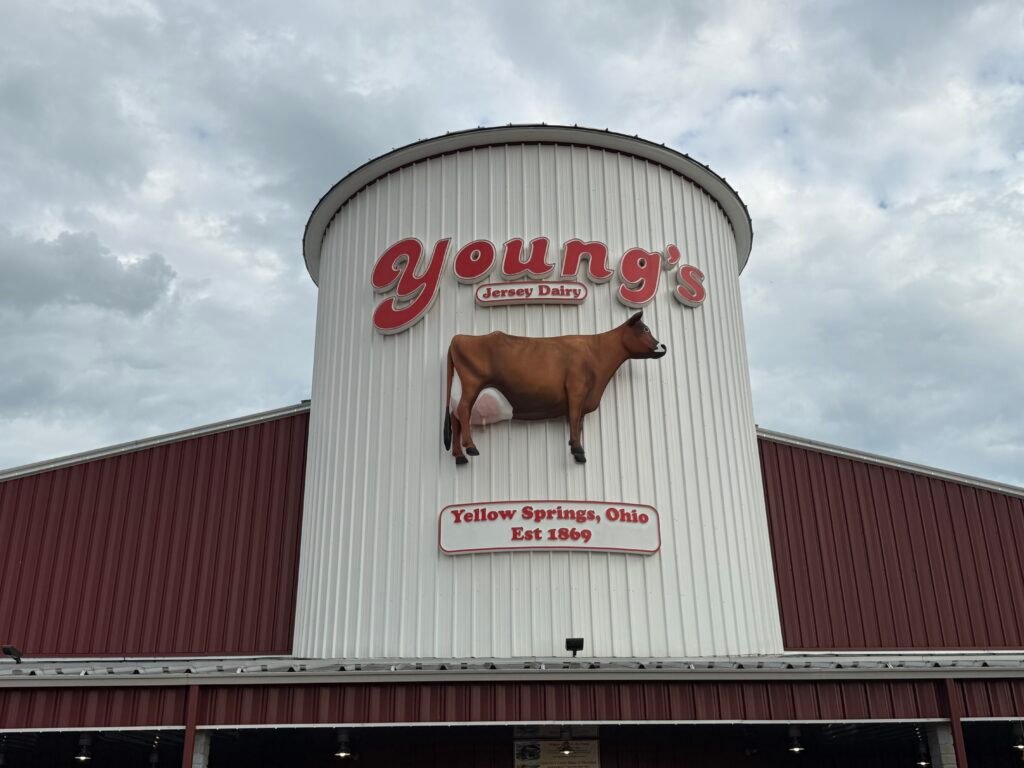
The red barn went up in 1869. The Young family lost the farm during the Depression and bought it back after the war, when Hap Young took on sixty acres and worked it with his sons Carl, Bob, and Bill—grain, hogs, and cows. In 1958 they started selling their Jersey milk out of a small room off the milk house: you pulled up, opened the refrigerator, took a gallon, left your money and your empty jug, and drove home. Sixty cents. The first real dairy store followed in 1960. Everything after that is accretion—cheese, a bakery, sandwiches, ice cream, a restaurant, then miniature golf in 1993, a driving range in 1995, batting cages in 1996. Cowvin, Cowtherine, and the rest of the cartoon cow family arrived along the way; Cowtherine is named after Cathy Young. The place now clears a million visitors a year and is still run by the family, five generations in.
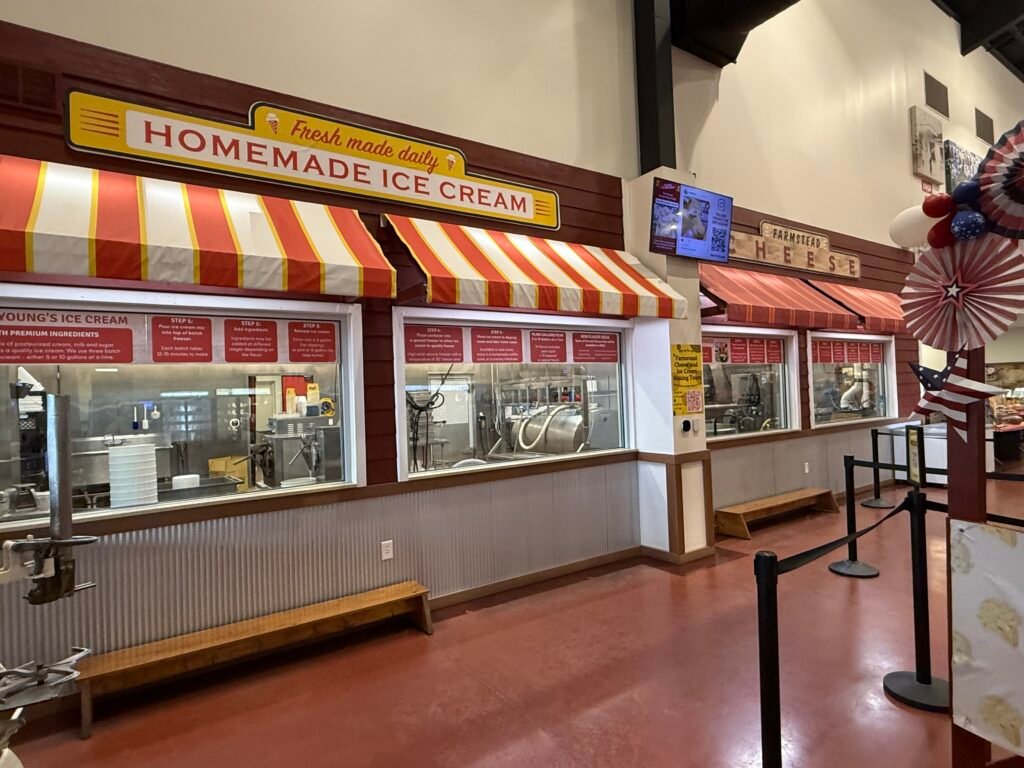
It was packed. Hundreds of people, every seat taken, a line at a counter that runs most of the length of the wall under six or seven menu boards—chocolate collection, creative caramels, seasonal sensations, fruits nuts and berries, a full grill menu underneath. They hand you a pager, the kind a restaurant gives you while you wait for a table, and buzz you when the order is up. Alongside the ice cream they sell confections, breads, honey, and jams. Out back, in its own red building, Cowtherine’s Carousel turned with its lights on.
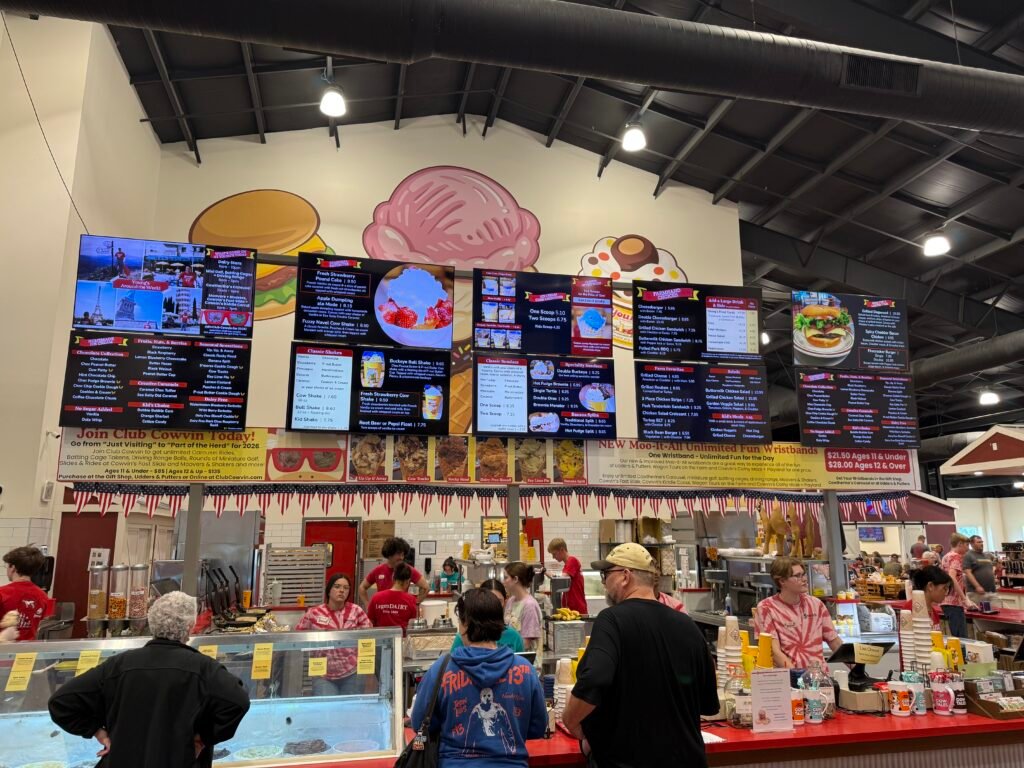
Which is worth sitting with for a second. The village that had hosted thirty thousand people the previous day was quiet enough to hear your own footsteps. The dairy three miles up the road, on an ordinary Sunday with nothing scheduled, was mobbed.
I ordered a fresh strawberry cow shake and swapped the standard French vanilla for strawberry ice cream. Real strawberries blended through it, cold milk, whipped cream, a whole berry on top, two straws thick enough to move it.
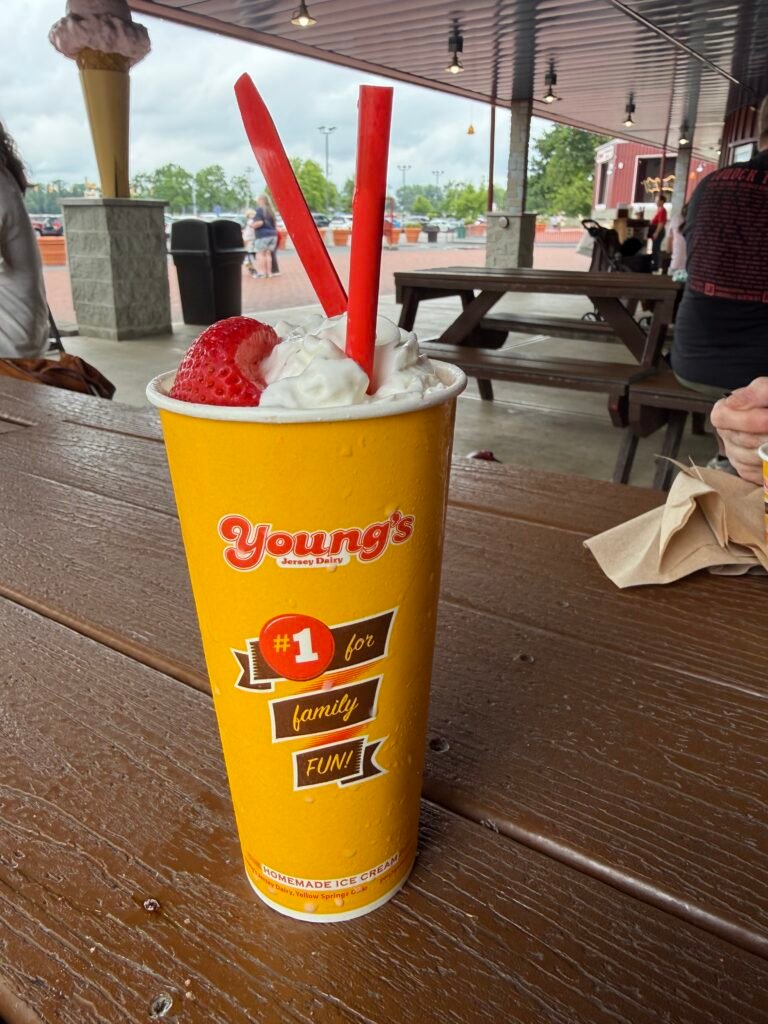
Here is the part I had wrong going in. I assumed I was tasting Jersey milk, since Jerseys are famous for butterfat and the sign out front says Jersey Dairy. I wasn’t. Young’s posts the whole operation on the glass—viewing windows onto the production rooms, the cheese process broken into ten numbered steps, a vat of curd turning while you read them. The herd’s milk goes into the farmstead cheese. The ice cream is made on the farm from a fifteen-percent butterfat mix trucked in from Reiter Dairy over in Springfield. Fifteen percent is a lot. Federal minimum for anything you’re allowed to call ice cream is ten. So the shake wasn’t a Jersey genetics story. It was a very rich mix, churned in small batches on site, with real fruit in it. It is the best strawberry shake I have ever had, and it is not close. If you want the cows themselves, order the cheese curds.
Buc-ee’s
Then I drove twenty minutes west and went somewhere with no history at all.
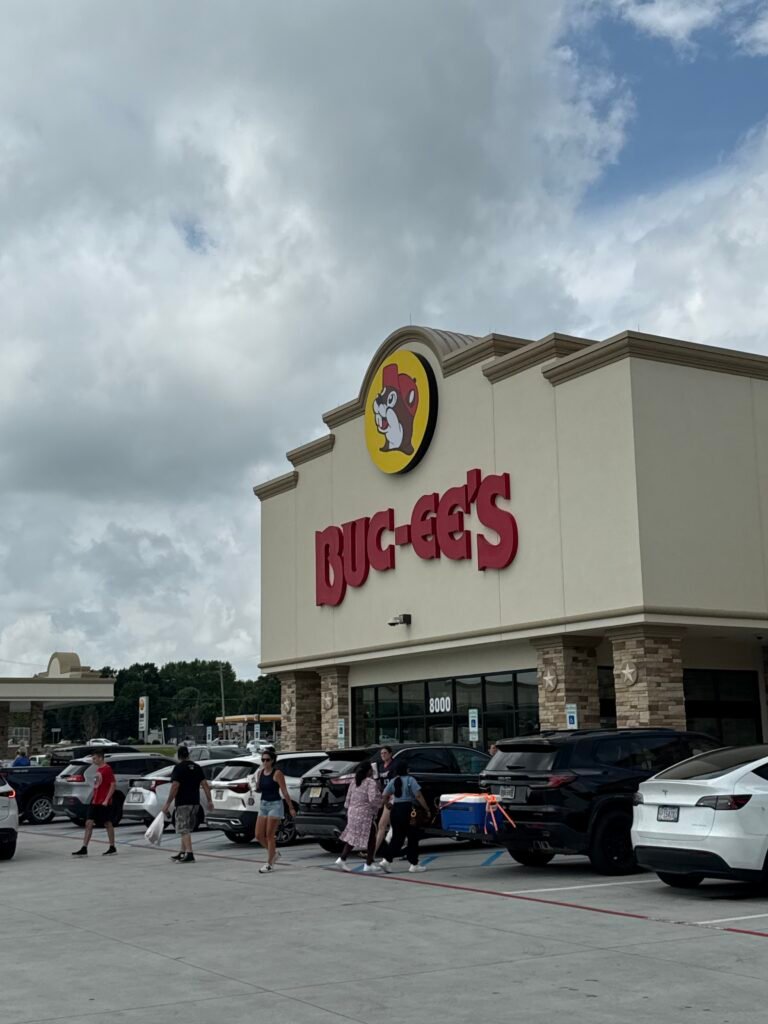
Ohio’s first Buc-ee’s opened April 6, 2026, at 8000 State Route 235 in Huber Heights, where SR 235 meets I-70. Seventy-four thousand square feet on a fifty-three-acre site. More than a hundred fueling positions. Seven hundred parking spaces. Roughly sixty million dollars, two hundred jobs, the governor at the ribbon cutting, and over a million dollars in sales on the first day—a record for the chain. It does not close, ever. It also does not permit semi trucks, which makes it a truck stop that has banned trucks.
Inside: brisket chopped to order and called out across the room, walls of jerky, Beaver Nuggets by the sack, fudge, kolaches, and an amount of beaver-branded apparel that has to be seen. The bathrooms are the thing everybody mentions and everybody is right about them.
Nothing in that building is from Huber Heights. That is the entire design. A Buc-ee’s in Ohio is identical to a Buc-ee’s in Alabama, which is the promise—you know exactly what you are walking into, wherever you are, whatever hour it is. It is the precise opposite of an 1827 log cabin with a German menu because of a baker who died a century ago.
I enjoyed it thoroughly. If you pass one, you stop. I’m not going to pretend otherwise, and I’m not going to pretend the two things reconcile.
What I Didn’t Do
I never got to Glen Helen. The spring the town is named for is down in there, along with a thousand acres of gorge and trail, and I drove home without walking a foot of it. Same for John Bryan, next door. That is what a day trip costs you.
So there’s a list now. The preserve. The gorge. The October fair, which is the second Saturday like the June one. And another one of those shakes, which is not a joke and is not a minor entry.
What I Was Standing In
Here is what I keep coming back to.
I spent a morning in a village looking for evidence of something enormous that had happened there, and I couldn’t see it. It took two strangers and a sold-out appetizer to convince me.
And it took two months for me to notice that I had spent that same morning walking through three shops full of Ganesha and had registered nothing beyond the fact that there were an awful lot of him. Remover of obstacles. Patron of beginnings, invoked before journeys and before anything new gets started. Everywhere I looked, that day, in a town I went to because I needed to be somewhere that wasn’t home, at a point in my life when the obstacles are the whole situation.
I’m not going to make it mean anything. I don’t believe I was being told something. But it’s worth knowing that older traditions give him the opposite role as well: the one who sets obstacles in the road of those who need to be checked. The figure is the same either way. You don’t get to know which one you’re dealing with while you’re standing in front of it.
I walked right past a hundred of them.
Practical Notes
Yellow Springs Street Fair — Second Saturday of June and second Saturday of October; the next one is October 10, 2026. Vendors 9 to 5, free admission, pet-free by village ordinance. Roughly 30,000 people at the June fair. Overflow parking and shuttles from Young’s Jersey Dairy. Details at yellowspringsohio.org.
Downtown — Xenia Avenue is the spine, and the whole district is walkable in an afternoon. Little Fairy Garden sits off the King’s Yard strip — up the ramp, around the far side of the building, in at the corner. Ye Olde Trail Tavern, 228 Xenia. Bonadies Glass Studio, Asanda Imports at 230 Xenia, Tibet Bazaar, and Pangea Trading Company are all within a few blocks.
Ye Olde Trail Tavern — German-American menu, two patios, open daily. If the sauerkraut balls are on, get the sauerkraut balls.
Young’s Jersey Dairy — 6880 Springfield-Xenia Road, three miles from downtown. Dairy store, Golden Jersey Inn, carousel, mini golf, batting cages, petting area, and a farm-goods counter. Open year-round. Full details at youngsdairy.com. Get the fresh strawberry cow shake.
Glen Helen Nature Preserve and John Bryan State Park — Immediately southeast of the village. I didn’t get to either. Budget more than a day if you want them.
Buc-ee’s Huber Heights — 8000 State Route 235, Exit 41 off I-70, about twenty minutes west. Open 24/7/365. No semis.

Discover more from Rogue Wayfarer
Subscribe to get the latest posts sent to your email.